
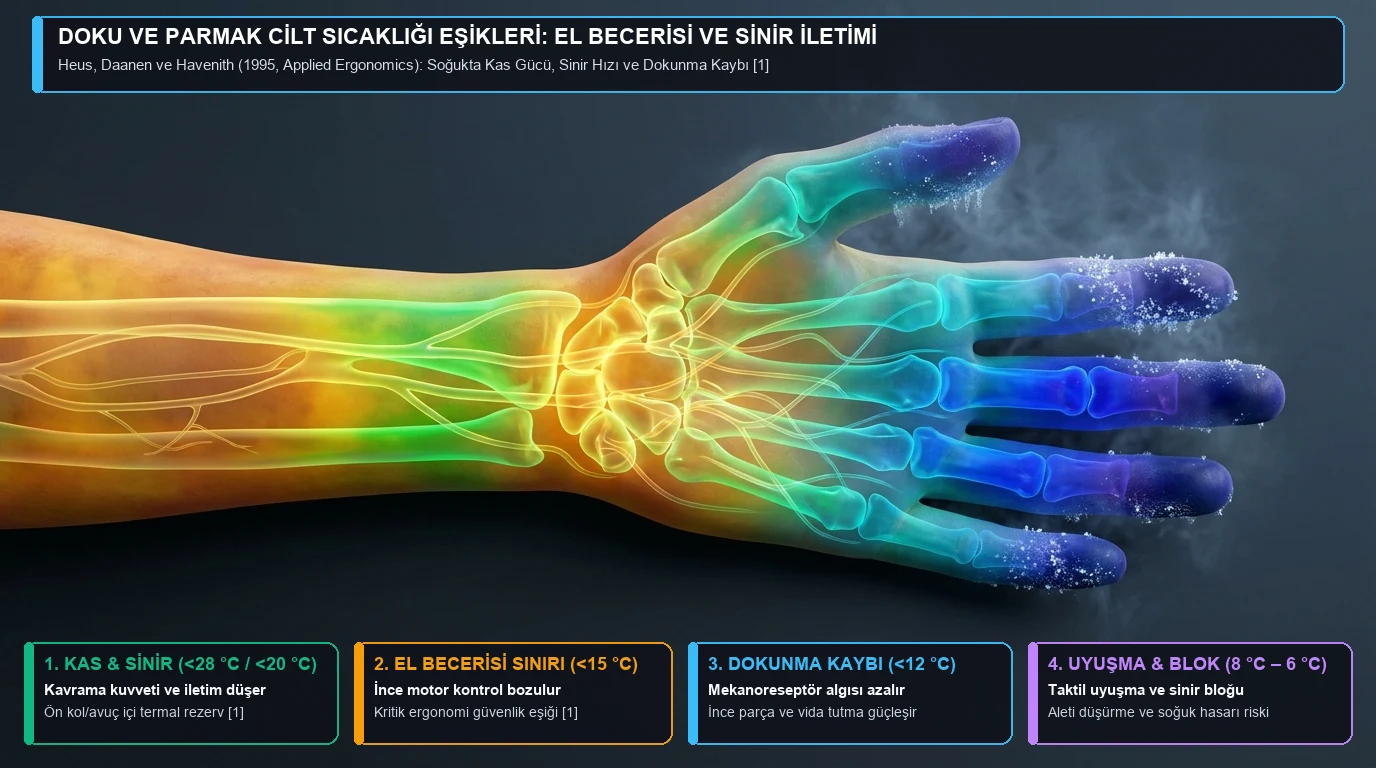
- → Manual Dexterity Declines Below 15 °C: When finger skin temperature drops below 15 °C, fine motor control deteriorates; below 12 °C, tactile sensitivity diminishes; and around 8 °C, clinical numbness sets in (Heus, Daanen, & Havenith, 1995).
- → The Brain Prioritizes Core Organs: When the body senses cold, arteriovenous anastomoses in the fingertips constrict, shunting warm blood inward to defend core organs (Daanen, 2003; Cheung, 2015).
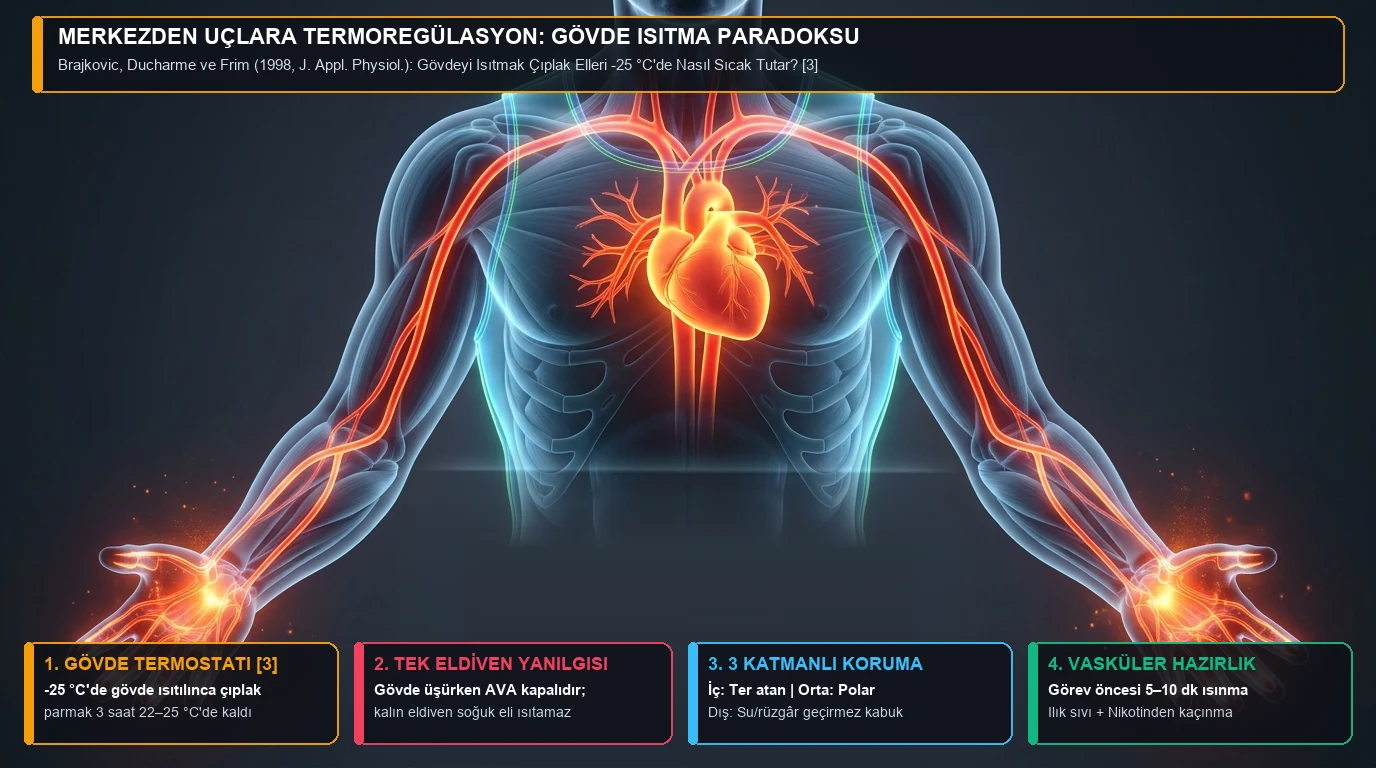
- → Warming the Torso Keeps Bare Hands Warm: In an extreme trial at -25 °C, individuals whose torsos were actively heated maintained comfortable bare hand temperatures for 3 full hours (Brajkovic et al., 1998).
- → Vibrating Power Tools Increase Vascular & Nerve Risk 7-Fold: Prolonged use of rotary hammers or grinders elevates the risk of cold-induced white finger by ~7-fold and permanent neurosensory impairment by ~7.4-fold (Nilsson et al., 2017).
⚠️ Informational Notice: This article is strictly for educational purposes based on peer-reviewed biomedical literature and does not substitute for clinical medical examination, diagnosis, or personalized treatment. If you experience sharply demarcated pallor, cyanosis, severe pain, persistent numbness, or tissue ulceration on your fingertips upon cold exposure, consult an internist, rheumatologist, or vascular specialist.
In Brief
- When finger skin temperature drops below 15 °C, manual dexterity breaks down; around 8 °C, profound numbness sets in [1].
- When your body senses environmental cold, your brain aggressively shunts blood flow away from the extremities to preserve core temperature in the heart and brain [2, 5].
- Wet gloves conduct heat away from the skin 25 times faster than dry air, freezing hands within minutes [1, 5].
- The single most potent physiological strategy to keep fingers warm is keeping your chest and back thoroughly insulated; when core temperature is maintained, the brain keeps peripheral vascular gates open [3].
Sounds Familiar?
On a freezing winter morning, you stand outside your front door. You pull your house key from your bag, but your fingers are so rigid and unresponsive that you fumble repeatedly, unable to align the key with the lock.
Or perhaps you work in an unheated warehouse, on an outdoor construction site, or in a cold-storage facility: you realize you can barely grip a screw, manipulate a barcode scanner, or type on your smartphone because your hands feel like stiff blocks of wood. Even inside thick winter gloves, an icy ache persists.
Why do our hands surrender so rapidly while the rest of our body manages reasonably well? In this guide, we break down the neurovascular mechanics of cold-induced hand dysfunction and explain the clinically proven ways to keep your fingers warm.

1. Why Do Fingers Turn “Wooden” in the Cold?
The human hand is an evolutionary masterpiece of tactile feedback and biomechanical precision, yet it possesses a major physiological vulnerability: digits contain virtually no large, heat-generating muscle tissue [5]. Furthermore, their high surface-area-to-volume ratio causes them to radiate heat into the ambient air at an alarming rate.
What Happens as Temperature Drops?
Dutch ergonomics researchers Ronald Heus, Hein Daanen, and George Havenith systematically quantified how human hands lose functionality in sub-optimal thermal conditions [1]:
- Forearm musculature cooling (below 28 °C): Deep muscles in the forearm that control wrist and finger flexion slow down enzymatic and contractile rates, causing grip strength to plummet [1].
- Peripheral nerve conduction cooling (below 20 °C): Afferent sensory and efferent motor nerve fibers conduct electrical impulses with marked latency [1].
- Finger skin cooling (below 15 °C): This represents the critical functional threshold encountered in daily life [1].
| Finger Skin Temperature | Functional Impairment |
|---|---|
| Below 15 °C | Fine manual dexterity deteriorates; buttoning a shirt or turning a key becomes cumbersome [1]. |
| Below 12 °C | Tactile acuity drops sharply; you can no longer accurately perceive object textures or edges [1]. |
| Around 8 °C | Profound sensory numbness sets in, drastically increasing the risk of dropping tools or objects [1]. |
The Brain’s Ruthless Calculation: Core vs. Digits
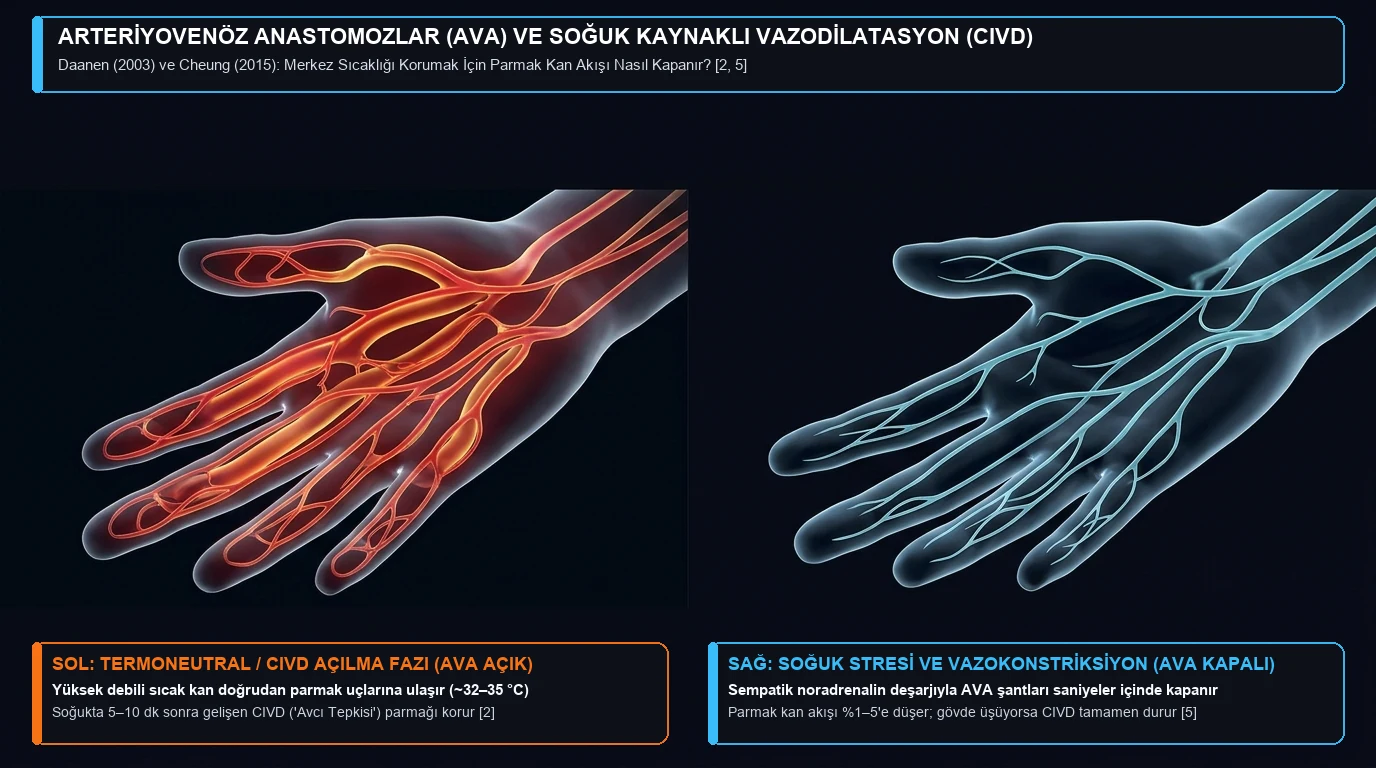
Because digits cannot produce metabolic heat on their own, they depend entirely on convective heat delivered by arterial blood pumped from the core. In human palms and fingertips, circulation is dominated by arteriovenous anastomoses (AVAs)—specialized vascular shunts that connect arterioles directly to venules, bypassing capillary beds [2, 5].
Think of these AVAs as biological thermostatic radiator valves:
- When the body is warm: AVAs are wide open. Massive volumes of warm blood surge through the digital vascular beds, dissipating excess heat to the environment [2, 5].
- When the body feels cold: The sympathetic nervous system initiates profound cutaneous vasoconstriction to defend the vital 37 °C core temperature of the heart, lungs, and brain [2, 5]. Within seconds, digital AVAs clamp shut. Capillary perfusion in the fingertips can plunge by more than 99%, instantly plunging hands into thermal deficit [5].
The Cyclic Warming Surge: 5–10 Minutes In
In healthy individuals exposed to local cold, an intriguing protective reflex engages approximately 5 to 10 minutes after digital skin temperature drops below 15 °C [2]. To prevent ischemic necrosis and irreversible frostbite, the autonomic nervous system briefly relaxes digital vascular smooth muscle, unleashing a transient rush of warm blood into the fingertips before clamping shut again [2].
This rhythmic cycle of transient vasodilation and constriction is medically termed Cold-Induced Vasodilation (CIVD), or the “hunting reaction” [2]. However, there is a non-negotiable caveat: If your body core is experiencing negative thermal balance, the hypothalamus completely overrides and suppresses the CIVD response [2, 5].
2. Why Wet Gloves and Wind Freeze Hands 25 Times Faster
Even when a thermometer indicates a moderate winter temperature, high wind speed and moisture turn the cold brutal. This stems from two fundamental laws of thermodynamics:
- Wind Strips the Microclimatic Boundary Layer: Your skin maintains an invisible, millimeter-thin envelope of warm, still air. Hein Daanen’s classic wind-chill experiments at 0 °C, -10 °C, and -20 °C demonstrated that increasing wind velocity strips this insulating air blanket away, triggering rapid convective heat loss and immediate dexterity collapse [2].
- Water Conducts Heat 25 Times Faster: Liquid water has a thermal conductivity approximately 25 times higher than stagnant air. When gloves become saturated from winter rain, melting snow, or trapped palmar perspiration, insulating dead air spaces are displaced by water, causing hand temperatures to plummet below 15 °C in minutes [1, 5].

3. Why Do Fingers Turn Chalk-White? Raynaud’s and Vibrating Tools
In certain individuals, cold exposure or emotional surges transcend standard vasoconstriction, triggering an intense, pathological spasm that entirely obliterates digital blood flow.
Raynaud’s Phenomenon: The Triphasic Color Attack
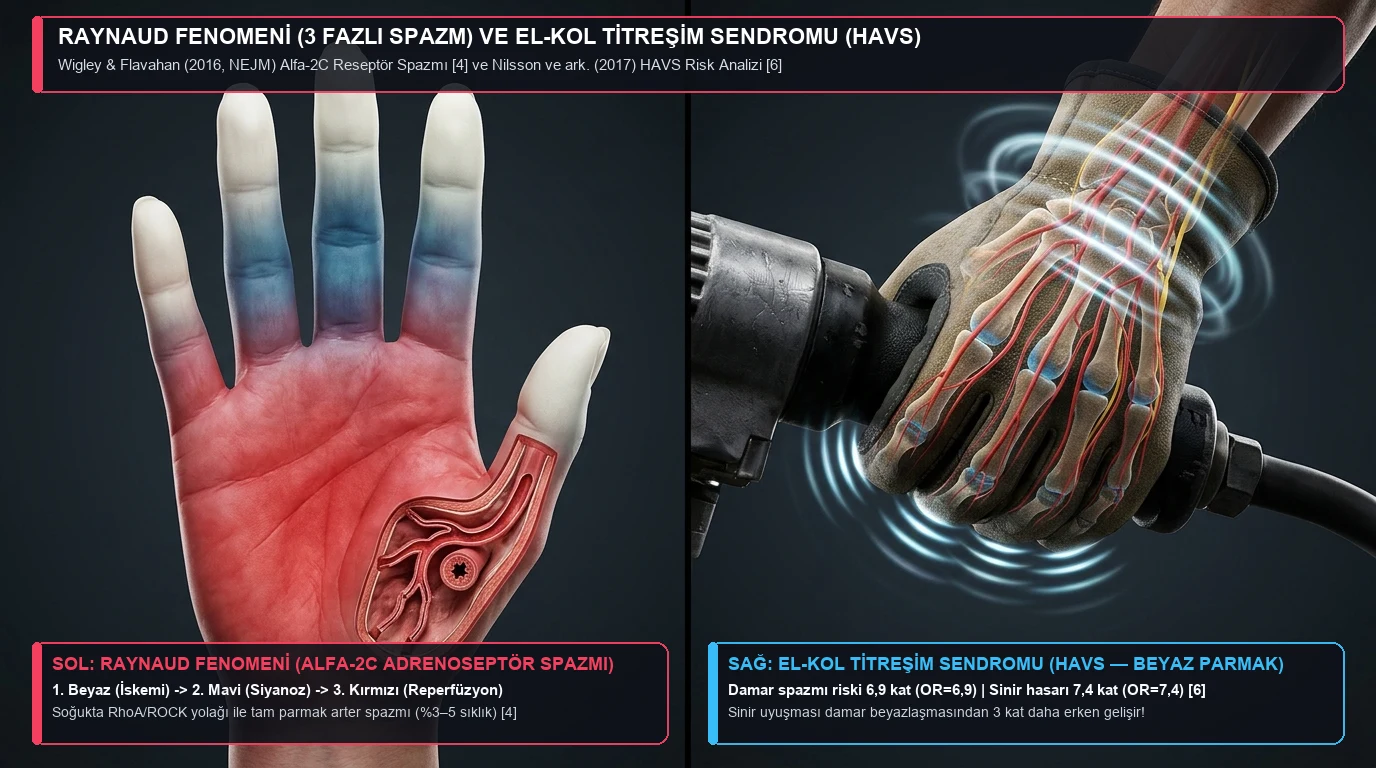
In an authoritative clinical review, rheumatologists Fredrick Wigley and Nicholas Flavahan outline how Raynaud’s phenomenon, affecting approximately 3% to 5% of the general population, involves hyper-reactive alpha-2 adrenergic receptors on digital vascular smooth muscle [4]. This triggers a striking triphasic color sequence [4]:
- Pallor (White): Complete arteriolar spasm abruptly arrests blood flow; fingers turn chalk-white, cold, and numb.
- Cyanosis (Blue): As static red blood cells in the microcirculation surrender their remaining oxygen to tissues, digits assume a mottled purple-blue hue.
- Rubor (Red): Upon rewarming, reactive hyperemia floods the vascular bed, causing intense throbbing, burning sensations, and vivid redness [4].
While primary Raynaud’s appearing symmetrically in youth is generally benign, late-onset or asymmetric attacks warrant thorough medical evaluation to rule out systemic connective tissue disorders [4].
The Occupational Hazard of Vibrating Tools (HAVS)
Workers operating rotary hammer drills, angle grinders, pneumatic tampers, or chainsaws for prolonged periods face severe neurovascular damage termed Hand-Arm Vibration Syndrome (HAVS) [6].
A landmark meta-analysis led by Swedish researcher Tohr Nilsson revealed alarming occupational risks among tool operators [6]:
- Vibration-induced white finger (VWF) risk increases by 6.9-fold.
- Permanent neurosensory numbness and paresthesia risk escalates by 7.4-fold [6].
- Notably, neurological nerve entrapment and sensory deficits develop approximately three times faster than vascular blanching, while carpal tunnel syndrome risks rise 2.9-fold [6].
4. The Real Secret to Warm Hands Lies in Your Torso
If your hands remain icy despite wearing thick, insulated gloves, the explanation is simple: Gloves do not generate heat; they merely trap existing thermal energy. If your core is losing heat, your brain refuses to pump warm blood to your fingers. Wrapping a cold bottle in a wool blanket will not warm it up—and unperfused fingers inside an insulated glove remain freezing [3, 5].
The -25 °C Bare-Hand Experiment
In a landmark defense research trial in Canada, Dragan Brajkovic and colleagues demonstrated this biological truth in astonishing fashion [3]:
- Human subjects were seated in an extreme environmental chamber at -25 °C (-13 °F) for 3 consecutive hours.
- The participants wore completely bare hands (no gloves whatsoever), but their torsos were actively heated using an electrically warmed thermal vest [3].
- The Result: Because their core remained in a state of positive thermal balance, the hypothalamus never triggered digital vasoconstriction. Warm arterial blood continued to pulse through the hands, keeping bare finger skin temperatures comfortably at 22–25 °C throughout 3 hours of sub-zero exposure [3].
What Can You Do? 4 Practical Steps
- 1. Heavily insulate your core first: If your fingers are numb, add a high-loft fleece vest or thermal baselayer over your chest and back; core heating re-opens digital vessels [3].
- 2. Choose roomy, completely dry gloves: Tight gloves compress superficial digital arteries and strangle capillary refill; immediately swap damp gloves for dry spares [1, 5].
- 3. Avoid nicotine before cold exposure: Nicotine is a potent peripheral vasoconstrictor that accelerates cold-induced ischemic digital drop [4].
- 4. Avoid excessive grip force on power tools: Minimize clamping grip on vibrating equipment, use anti-vibration gloves, and enforce structured warming breaks [6].
The simplest and most transformative step is the first: Adding a warm, insulated vest beneath your outer jacket. If you work on keyboards, use smartphones, or handle precision tools in cold environments where bulky mittens are impractical, keeping your core toasty is the most powerful physiological biohack to delay finger numbness [3].

Related Reading
- Understand why vibrating hand tools and bicycle handlebars cause prolonged tingling in our guide on Vibrating Tools, Hand Numbness, White Finger, and Vascular-Nerve Health.
- Explore peripheral nerve entrapment mechanisms in Wrist Biomechanics and Carpal Tunnel Prevention.
- Discover metabolic responses and thermogenesis in Does Feeling Cold Burn Fat? What We Know About Brown Adipose Tissue.
- Learn how chronic sympathetic activation impairs autonomic balance in our Work Stress, Burnout, and HRV Guide.
How Much Can We Trust the Evidence?
| Finding | Evidence Level |
|---|---|
| Dexterity loss below 15 °C finger skin temperature and tactile loss below 12 °C | 🟢 Strong |
| Core body heating preventing peripheral vasoconstriction and maintaining digital perfusion | 🟢 Strong |
| Vibrating power tool usage multiplying white finger (6.9x) and nerve impairment (7.4x) risks | 🟢 Strong |
| Cold-sensitive cutaneous adrenoreceptor hyper-reactivity triggering Raynaud’s vasospasm | 🟢 Strong |
| Habitual cold water immersion inducing permanent baseline digital vasodilation | 🟡 Emerging |
💡 What Do These Confidence Levels Mean?
- 🟢 Strong: Robust findings confirmed across multiple independent human clinical trials and systematic reviews.
- 🟡 Emerging: Preliminary clinical findings in restricted sample cohorts requiring broader verification.
- 🔴 Insufficient: Unsubstantiated claims lacking rigorous human empirical backing.
Frequently Asked Questions
Why do my hands freeze and turn numb within minutes of stepping into the cold?
When ambient cold hits, your autonomic nervous system immediately closes digital arteriovenous anastomoses to preserve the 37 °C core temperature of your heart and brain [2, 5]. Because digits have no large muscle mass to generate localized heat, skin temperature drops rapidly; manual dexterity collapses below 15 °C, and numbness sets in near 8 °C [1].
Why don’t my fingers warm up even when wearing heavy winter gloves?
Gloves possess no intrinsic heat source; they solely reflect and insulate the heat supplied by your circulating blood [3, 5]. If your torso is under-insulated and chilly, your brain restricts peripheral circulation, leaving your gloves to insulate unperfused, cold tissue [3].
What do chalk-white or purplish fingers indicate after cold exposure?
Sharply demarcated blanching, followed by cyanosis and painful red throbbing upon warming, is the classic hallmark of Raynaud’s phenomenon [4]. Affecting 3–5% of the population, it can be primary (idiopathic) or secondary to autoimmune diseases or power tool vibration damage (HAVS) [4, 6].
Is it safe to thaw frozen, numb hands under hot water or against a radiator?
No. Because numbness impairs your temperature and pain thresholds, scalding water or hot metal surfaces can cause severe thermal burns and vascular reperfusion damage before you realize it [1]. Rewarm chilled hands gradually using lukewarm water (37–40 °C) or by placing them directly against your own warm axillae (armpits).
Conclusion
Finger numbness in the cold is not an isolated hand issue—it is an evolutionary survival reflex where the central nervous system sacrifices peripheral warmth to defend vital core organs. By aggressively insulating your chest and back, keeping gloves dry, avoiding vasoconstrictive agents like nicotine, and taking structured breaks from vibrating tools, you can preserve fine motor control and safeguard your long-term neurovascular health throughout winter.
Last Updated: October 2026
Verified References
- [1] Heus, R., Daanen, H. A., & Havenith, G. (1995). “Physiological criteria for functioning of hands in the cold: a review.” Applied Ergonomics, 26(1), 5–13. DOI: 10.1016/0003-6870(94)00004-i · PMID: 15676995
- [2] Daanen, H. A. M. (2003). “Finger cold-induced vasodilation: a review.” European Journal of Applied Physiology, 89(5), 411–426. DOI: 10.1007/s00421-003-0818-2 · PMID: 12712346. Additional citation: Daanen, H. A. M. (2009). “Manual performance deterioration in the cold estimated using the wind chill equivalent temperature.” Industrial Health, 47(3), 262–270. DOI: 10.2486/indhealth.47.262 · PMID: 19531912
- [3] Brajkovic, D., Ducharme, M. B., & Frim, J. (1998). “Influence of localized auxiliary heating on hand comfort during cold exposure.” Journal of Applied Physiology, 85(6), 2054–2065. DOI: 10.1152/jappl.1998.85.6.2054 · PMID: 9843526
- [4] Wigley, F. M., & Flavahan, N. A. (2016). “Raynaud’s Phenomenon.” New England Journal of Medicine, 375(6), 556–565. DOI: 10.1056/NEJMra1507638 · PMID: 27509103. Additional citation: Wigley, F. M. (2002). NEJM, 347(13), 1001–1008. PMID: 12324557
- [5] Cheung, S. S. (2015). “Responses of the hands and feet to cold exposure.” Temperature, 2(1), 105–120. DOI: 10.1080/23328940.2015.1008890 · PMID: 27227009
- [6] Nilsson, T., Wahlström, J., & Burström, L. (2017). “Hand-arm vibration and the risk of vascular and neurological diseases—A systematic review and meta-analysis.” PLOS ONE, 12(7), e0180795. DOI: 10.1371/journal.pone.0180795 · PMID: 28704466
For informational purposes only; consult a physician for medical diagnosis or treatment.