
- → Mismatch between abundance and biology: Shaped over millennia of scarcity, the human brain struggles in today's non-stop stream of high-reward digital stimuli like 'a cactus in the rainforest' (Lembke, 2021, 2023).
- → The pleasure–pain balance is a clinical metaphor: Post-reward restlessness aligns with opponent-process theory, yet Lembke explicitly notes that the seesaw image is a simplified metaphor rather than a literal lab measurement (Solomon & Corbit, 1974; Lembke, 2021).
- → Environmental self-binding beats raw willpower: Placing concrete physical and visual barriers—such as keeping the phone in another room and enabling grayscale—measurably reduces screen time in randomized controlled trials (Olson et al., 2023).
- → Fixed-length 'dopamine resets' are not universal laws: Taking a structured break helps expose automatic habits, but it does not literally reset brain dopamine, nor is there a single proven recovery timeline for everyone (Harvard Health, 2020/2024).
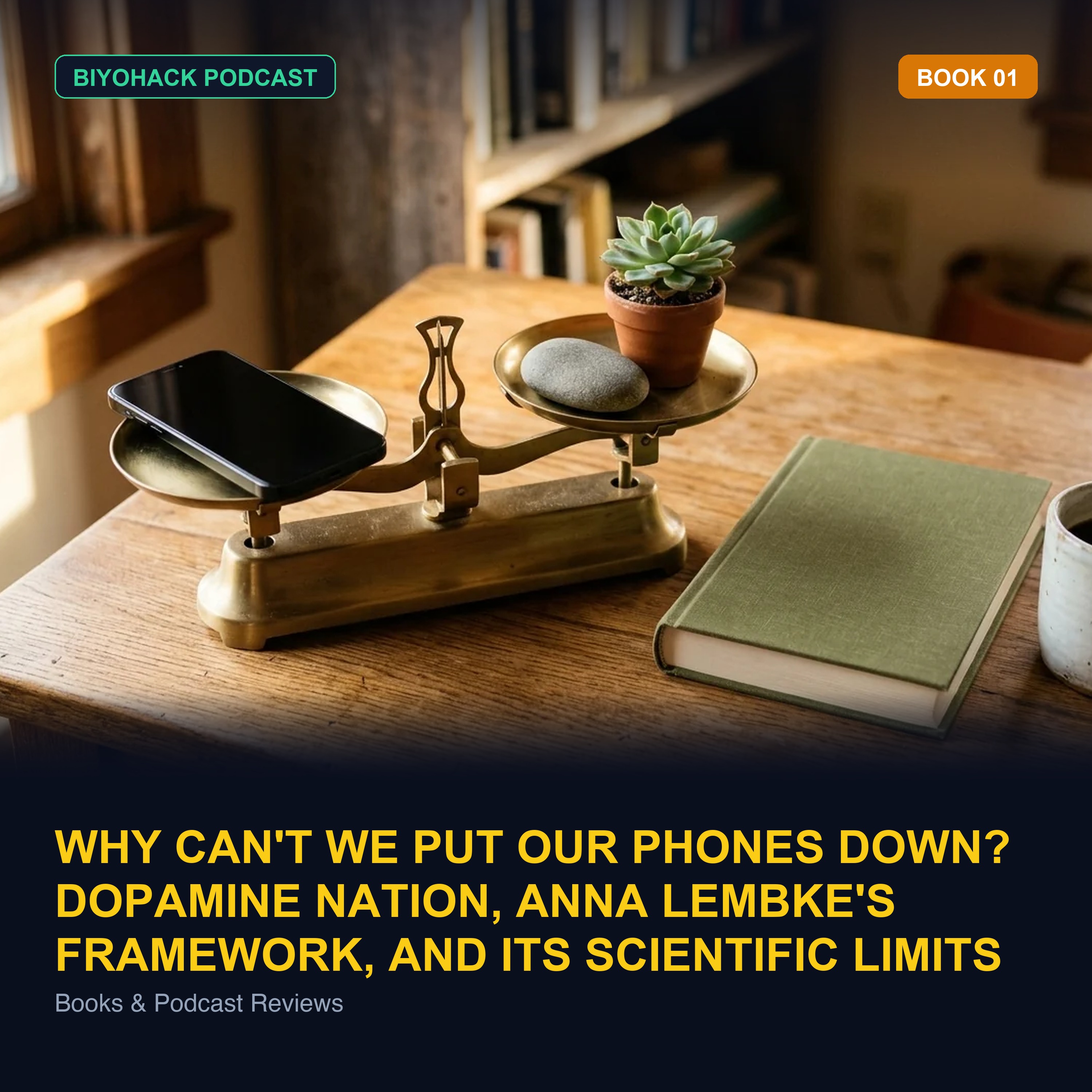
Why Can't We Put Our Phones Down? Dopamine Nation, Anna Lembke's Framework, and Its Scientific Limits
Book 01 short clip · AI voice synthesis
Book 01 short clip · AI voice synthesis
Book 01 short clip · AI voice synthesis
Book 01 short clip · AI voice synthesis
Book 01 short clip · AI voice synthesis
⚠️ Scope & Transparency Note: This evaluation draws on the accessible official excerpt from Dr. Anna Lembke’s Dopamine Nation: Finding Balance in the Age of Indulgence [1], her academic interviews and seminar slide decks [2, 3], and the publisher’s overview of her companion workbook [4]. It is not a cover-to-cover review of the full book; independent peer-reviewed studies [5–9] have been added to clarify the underlying neurobiology. This article is for informational purposes only and does not replace medical diagnosis or addiction treatment—especially for severe alcohol or substance dependence, where abrupt cessation requires medical supervision.
At a Glance
- Dr. Anna Lembke frames compulsive scrolling, shopping, and instant reward-seeking through what she calls the “Paradox of Plenty” [1, 3].
- At the center of her framework sits the pleasure–pain balance—which Lembke herself explicitly describes as a clinical metaphor, not a literal mechanical device inside the skull [1, 2].
- Rather than testing willpower every few minutes, self-binding—placing physical, chronological, and visual barriers between yourself and the screen—is the most practical takeaway [3, 8].
- Viral social-media claims of a “complete 30-day dopamine reset” overstate the science; structured pauses serve primarily as a behavioral observation window rather than a literal neurochemical wipe [2, 9].
Sound Familiar?
You pick up your phone just to check the time or reply to a single message. You expect it to take ten seconds—yet half an hour vanishes, and instead of feeling refreshed, you put the screen down feeling strangely restless.
Then comes self-blame: “Why do I have zero self-control?” In Dopamine Nation, Stanford University addiction psychiatrist Dr. Anna Lembke argues that the core problem is not a personal moral defect or uniquely weak willpower [1, 2].
How does Lembke explain this loop, which of her practical tools hold up in everyday life, and where do popular internet summaries exaggerate the neuroscience? Let’s walk through her framework and its scientific boundaries in plain language.
1. The Core Premise: “A Cactus in the Rainforest”
Lembke starts from the mismatch between modern access to frictionless rewards and ancient human physiology [1, 3]—a mismatch she calls the Paradox of Plenty.
For most of human history, food, social novelty, and safety required sustained physical effort under conditions of scarcity and uncertainty. Today, smartphones, infinite social feeds, online gaming, one-click shopping, and ultra-processed foods sit permanently within arm’s reach [3].
Borrowing a vivid analogy from her colleague Dr. Tom Finucane, Lembke compares our brains to a desert cactus transplanted into a rainforest: adapted to conserve every rare drop in arid conditions, the cactus drowns when surrounded by relentless moisture [1, 3]. Her central question is straightforward: how do we preserve satisfaction and mental equilibrium when constant stimulation becomes the default environment [1]?
2. The Pleasure–Pain Balance: What It Explains and Where the Metaphor Ends
Lembke explains that pleasure and pain are processed in overlapping brain regions that behave like two sides of a seesaw (balance) [1].
Opponent processes and habituation
Neurobiologically, this narrative builds on opponent-process theory, formulated in the 1970s by psychologists Richard Solomon and John Corbit (every intense affective deflection triggers a delayed counter-response to restore homeostasis) [1, 5]. Addiction researchers George Koob and Michel Le Moal later showed how chronic overstimulation shifts the brain’s baseline reward threshold via allostasis [6].
Lembke illustrates this feedback loop using imaginary “neuroadaptation gremlins” hopping onto the seesaw [1]:
- When you swipe through a rapid stream of novelty or get a quick reward, the balance tips toward the pleasure side.
- To bring the beam back to level, self-regulating mechanisms press down on the pain and restlessness side; that subtle emptiness or urge for “just one more video” right after locking your phone is the after-response [1].
- With repeated high-frequency exposure, initial enjoyment shrinks while post-use restlessness and craving grow stronger [1, 7]. As neuroscientist Kent Berridge’s incentive-sensitization research demonstrates, the brain increasingly reaches for the cue not out of genuine liking (pleasure), but out of wanting—just to quiet the restless urge [7].
Limits of the metaphor
Online summaries often present this seesaw as if it were a rigid mechanical gauge inside the brain. Yet in the official published excerpt, Lembke explicitly cautions that the balance is “only a metaphor” and that real-world reward and aversion circuits are far more complex [1].
In her Stanford Department of Medicine interview, she likewise emphasizes that she is a clinician rather than a bench neuroscientist running cellular assays [2]. She uses the balance model because it gives patients an intuitive language for tolerance, withdrawal-like restlessness, and compulsive checking [2].
3. Practical Strategies Highlighted in the Source Material
Across the accessible excerpt, talks, and workbook overview, Lembke’s practical recommendations cluster into three areas [2, 3, 4]:
A. Structured pauses and the D.O.P.A.M.I.N.E. framework
Lembke recommends stepping away from a problematic consumption habit for a defined period [3, 4]. In her seminar slides she mentions a 24-hour digital pause as an accessible starting experiment, while her clinical talks and workbook discuss longer abstinence trials (often framed around roughly four weeks in clinical practice when medically safe) [2, 3, 4].
Crucially, this pause functions as a practical window to observe automatic urges and boredom—not as a literal chemical purge [3, 9]. As Harvard Medical School’s review on “dopamine detoxing” underscores, stepping back from screens does not deplete or “reset” brain dopamine levels; rather, it interrupts cue-driven behavioral loops [9]. (Note: for severe alcohol, benzodiazepine, or opioid dependence, abrupt cessation carries dangerous withdrawal risks and always requires medical supervision.)
Her eight-step D.O.P.A.M.I.N.E. clinical framework outlined in her presentations and workbook companion works as follows [3, 4]:
| Step | Everyday translation |
|---|---|
| D — Data | Track honestly what, how often, and for how long you consume or scroll. |
| O — Objectives | Name what you hope the habit will do for you (escape, relief, numbing boredom). |
| P — Problems | List the concrete costs to your sleep, focus, mood, or relationships. |
| A — Abstinence | Take a pre-committed, time-limited break from the specific behavior (when medically safe). |
| M — Mindfulness | Observe the restlessness and boredom that surface during the pause without immediately numbing them. |
| I — Insight | Notice which emotions, times of day, or cues trigger the automatic reach. |
| N — Next Steps | Decide in advance whether to abstain long-term or return with strict guardrails. |
| E — Experiment | Test your new boundaries in daily life and refine what breaks down. |
B. Self-binding: Designing your environment instead of relying on willpower
Lembke’s most immediately actionable concept is self-binding—creating intentional physical, chronological, or categorical barriers while calm so you do not have to fight raw impulse in the heat of the moment [3]. In her seminar slides, she groups self-binding into three categories [3]:
- Physical (spatial) barriers: Deleting triggering apps from your phone, keeping the phone in another room while working, and making the bedroom a screen-free zone [3].
- Chronological barriers: Keeping mealtimes screen-free or restricting recreational checking to narrow, pre-set time windows [3].
- Categorical & visual barriers: Stating your single purpose out loud before unlocking the screen, turning off non-human notifications, and switching the display to grayscale [3].
Independent experimental evidence backs this approach. In a 2023 randomized controlled trial at McGill University, simple nudge-based environmental changes—including grayscale display mode, disabling non-essential notifications, and keeping the phone out of immediate reach—significantly reduced daily screen time and problematic smartphone scores while improving sleep quality, even though effects are modest behavioral nudges rather than quick fixes [8].
C. Effortful challenges (“hormesis”) and their limits
Lembke also discusses choosing effortful activities over frictionless rewards—describing this as “paying for your dopamine upfront” [2, 3]. On her seminar slides, diverse practices such as physical exercise, cold-water immersion, intermittent fasting, meditation, and prayer appear together under this umbrella [3].
From the accessible materials alone, however, we cannot conclude that these very different practices share the exact same neurobiological pathway or act as standalone addiction treatments. While regular aerobic and resistance exercise is backed by strong human evidence for mood and executive function, practices like cold-water immersion carry cardiovascular precautions for vulnerable individuals and should not be treated as a magic “dopamine switch.”
4. What We Can Evaluate vs. Limits of Our Scope
Because this overview relies on the official excerpt, interviews, and seminar slides rather than the full text of the book, it is important to separate what can and cannot be verified within this scope:
| Directly evaluable from primary materials | Outside what these sources alone verify |
|---|---|
| Lembke’s Paradox of Plenty and pleasure–pain balance framing [1, 3] | Full clinical case histories and long-term patient follow-ups inside the book |
| The author’s own statement that the seesaw is a metaphor [1, 2] | Exact neurochemical magnitude or uniform recovery duration of fixed screen pauses |
| Practical structure of self-binding and the D.O.P.A.M.I.N.E. steps [3, 4] | Whether heterogeneous “effortful challenge” examples produce equivalent clinical effects |
5. What Can You Try Today? 4 Simple Steps
- 1. Put room-level distance between you and your phone: Flipping the phone face-down on your desk rarely stops habit loops; leave it outside arm's reach or in another room during focused work and sleep [3, 8].
- 2. Switch your phone to grayscale in the evening: Bright app badges amplify visual salience; removing color makes endless scrolling noticeably less sticky [3, 8].
- 3. Try a short observation pause: Treat a temporary screen break not as a "brain chemical reset," but as a low-pressure experiment to notice when your hand reaches for the phone automatically [3, 9].
- 4. Name one specific task before unlocking: Say "I'm checking the map" or "I'm replying to one text and locking it" before touching the screen to curb open-ended drifting [3].
The easiest place to start is step one: buying an inexpensive bedside alarm clock and charging your phone in the living room overnight breaks both late-night scrolling and first-minute morning checking in a single move.
Who Might Find This Book Useful?
- Readers worn out by screen habits: Anyone looking to cut compulsive phone checking through practical environmental design rather than guilt [3].
- Parents and educators: Adults seeking shared household boundaries around devices instead of repeating “just have more self-control” [3, 4].
- Fans of structured habit frameworks: Readers who prefer step-by-step self-observation and self-binding tools over vague motivational advice [4].
Related Guides
- Explore how notification chimes and pull-to-refresh mechanics hijack reward-seeking circuits in The Neurobiology of Notifications: Breaking the Dopamine Loop.
- If you stay up scrolling despite feeling exhausted, read Why We Scroll in Bed: Revenge Bedtime Procrastination and Practical Fixes.
- Compare how evening screen arousal disrupts NREM and REM sleep stages in our Why We Sleep (Matthew Walker) Review.
How Confident Can We Be?
| Finding | Confidence Level |
|---|---|
| Intense, repeated reward cues can trigger opponent restlessness and habituation | 🟢 Strong |
| Brain circuits for “wanting” (cue-driven urge) and “liking” (actual pleasure) can diverge | 🟢 Strong |
| Environmental nudges (grayscale, notification limits, physical distance) reduce screen time | 🟢 Strong |
| Time-limited screen pauses serve as a helpful behavioral self-observation tool | 🟡 Emerging |
| Claim that a “30-day dopamine detox completely resets everyone’s brain chemistry identically” | 🔴 Insufficient |
💡 What Do Confidence Levels Mean?
- 🟢 Strong: Confirmed across multiple independent human studies and broad clinical consensus.
- 🟡 Emerging: Supported by smaller human cohorts, clinical observation, or early-stage trials.
- 🔴 Insufficient: Unproven in human trials, contradicted by physiology, or overstated pop-science claims.
Frequently Asked Questions
Is the pleasure–pain balance a literal organ inside the brain?
No—Lembke explicitly describes it as a clinical metaphor [1]. It offers a clear shorthand for how reward and discomfort circuits interact through opponent processes without claiming to be a literal mechanical scale [1, 5].
Does a “dopamine detox” actually empty or reset dopamine in the brain?
No; dopamine is an essential neurotransmitter required for movement, attention, and learning, and you cannot “flush” it out through lifestyle pauses [9]. Stepping away from high-stimulation habits simply creates distance from cue-triggered urges so you can observe and reshape them [3, 9].
What is the easiest first step to cut down compulsive phone checking?
Move the phone out of sight and arm’s reach, and turn on grayscale mode [3, 8]. Controlled trials show that reducing visual salience and notification triggers measurably lowers daily screen time without relying on constant willpower [8].
Is a 30-day pause safe or realistic for every type of addiction?
Not automatically. While a temporary break from recreational social media is benign for most people, severe alcohol, sedative, or substance dependence can cause medically dangerous withdrawal; anyone facing clinical addiction should consult a physician rather than attempting abrupt solo abstinence.
Bottom Line
Dr. Anna Lembke’s Dopamine Nation shifts everyday screen friction away from moral self-blame and reframes it around biological mismatch and environmental design. When we read her seesaw model as the helpful metaphor she intended—rather than rigid lab dogma—the most durable takeaway is refreshingly simple: stop testing your willpower every five minutes, and build small, real physical distances between yourself and the screen.
Last Updated: November 2026
Verified References & Scientific Literature
Reviewed Author & Publisher Materials
- [1] Lembke, A. (2021). “Dopamine and the pleasure–pain balance” (Official excerpt from Dopamine Nation). Society for the Study of Addiction (SSA). Official Excerpt
- [2] Lembke, A., & Ashley, E. (2026). “Anna Lembke on Pleasure, Pain, and Recovery in a Dopamine-Driven World” (The Future of Medicine Podcast). Stanford Department of Medicine. Official Episode Page
- [3] Lembke, A. (August 2023). “Dopamine Nation: Finding Balance in the Age of Indulgence” (Seminar presentation slides). Dakota Medical Foundation. Presentation PDF
- [4] Penguin Random House Higher Education (April 2025; workbook release: October 2024). The Official Dopamine Nation Workbook: A Practical Companion. Workbook Overview · Main Book Page
Independent Peer-Reviewed Literature & Medical Institutions
- [5] Solomon, R. L., & Corbit, J. D. (1974). “An opponent-process theory of motivation: I. Temporal dynamics of affect.” Psychological Review, 81(2), 119–145. DOI: 10.1037/h0036128 · PMID: 4817611
- [6] Koob, G. F., & Le Moal, M. (2001). “Drug addiction, dysregulation of reward, and allostasis.” Neuropsychopharmacology, 24(2), 97–129. DOI: 10.1016/S0893-133X(00)00195-0 · PMID: 11120394
- [7] Berridge, K. C., & Robinson, T. E. (2016). “Liking, wanting, and the incentive-sensitization theory of addiction.” American Psychologist, 71(8), 670–679. DOI: 10.1037/amp0000059 · PMID: 27977239 · PMCID: PMC5171207
- [8] Olson, J. A., Sandra, D. A., Chmoulevitch, D., Raz, A., & Veissière, S. P. L. (2023). “A Nudge-Based Intervention to Reduce Problematic Smartphone Use: Randomised Controlled Trial.” International Journal of Mental Health and Addiction, 21(6), 3842–3864. DOI: 10.1007/s11469-022-00826-w · PMID: 35600564 · PMCID: PMC9112639
- [9] Harvard Health Publishing (2020/2024). “Do you need a dopamine detox?” Harvard Medical School. Harvard Health Article
For informational purposes only; consult a physician for medical diagnosis or treatment.