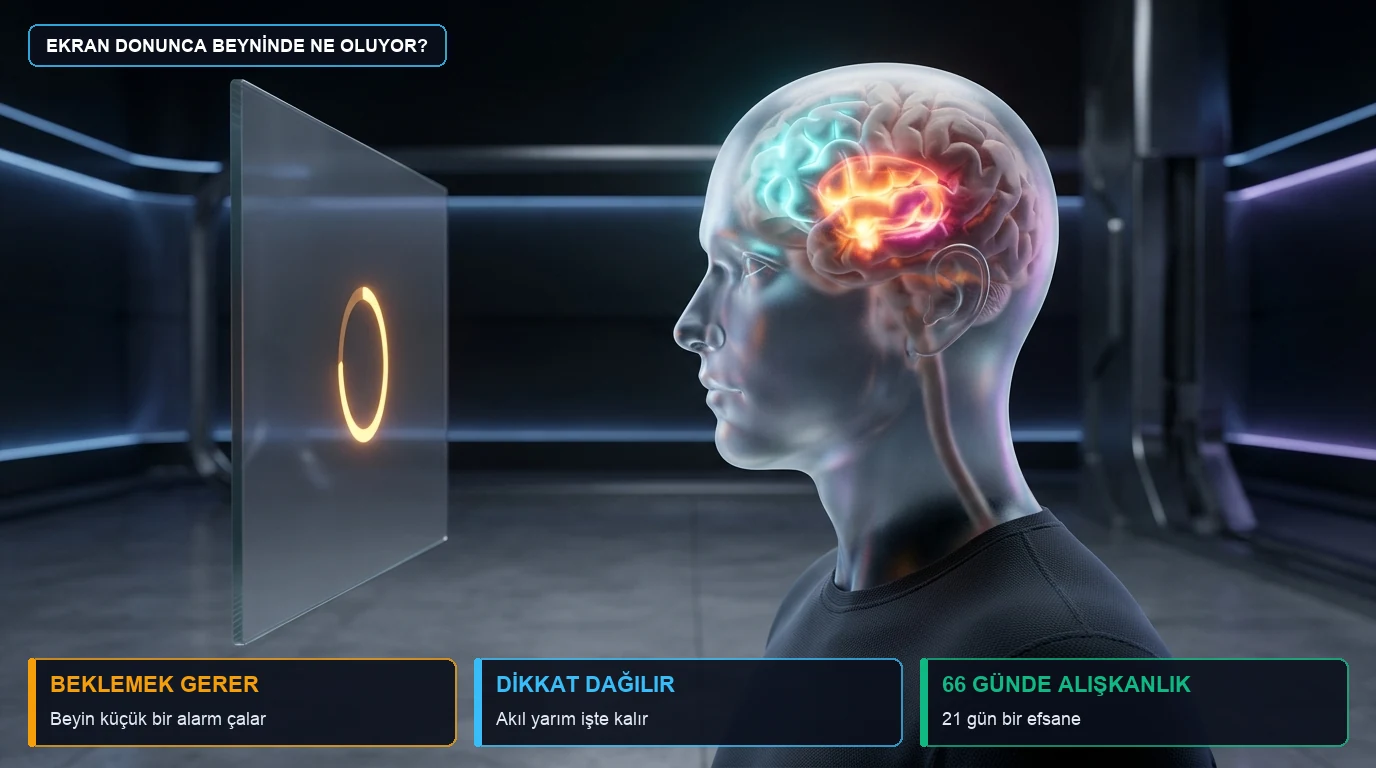
- → A multi-second delay sounds the brain's internal alarm: When an interface hangs unexpectedly, salience networks (anterior insula, dACC) fire, palmar skin conductance spikes, and keystroke force increases (Kohrs et al., 2014, 2016).
- → Context-switching while waiting leaves mental residue: Unfinished cognitive tasks keep subconscious neural loops running, degrading performance on subsequent tasks (Leroy, 2009).
- → Task-switching imposes a steep time tax: Shifting executive control between complex tasks can consume up to 40% of productive working hours (Rubinstein et al., 2001).
- → Habit automaticity takes 66 days, not 21: Shifting neural control from prefrontal cortex to the dorsolateral striatum requires consistent contextual repetition over an average of 66 days (Lally et al., 2010).
⚠️ Informational Notice: This article provides general educational information based on peer-reviewed neuropsychological and cognitive research and does not substitute for medical evaluation or clinical mental health guidance. If you experience chronic attentional fragmentation, anxiety, or burnout, consult a qualified healthcare provider.
In Brief
- Even a few seconds of unexpected interface lag triggers neurological alarms in the brain, treating system delays as a subtle threat [1, 2].
- Switching to your phone or opening a new browser tab while waiting leaves a substantial portion of your conscious attention stranded on the unfinished task [4].
- Regardless of how much you admire a new software tool, if it does not integrate seamlessly into your established daily cues, you will abandon it within days [8, 9].
- The good news: Each of these cognitive vulnerabilities can be mitigated through simple, evidence-based neuro-ergonomic habits.
Does This Sound Familiar?
You are compiling a major analytical report or you have just assigned a complex task to a generative AI model. Suddenly, the spinning progress indicator appears. 5 seconds… 30 seconds… 3 minutes…
What do you do? Almost reflexively, you pick up your phone, open your inbox, or switch to a social media tab. When you finally return to the original window, you stare blankly at the screen: “Wait, what was I in the middle of?”
In an October 2026 product review, tech executive Claire Vo tested a beautifully designed new autonomous AI agent. When asked to execute tasks, the agent worked silently in the background for over 10 minutes. Vo’s ultimate verdict was concise: “It’s beautifully built. Yet I completely forgot to use it.”
In this guide, we demystify the three neurobiological forces underpinning this universal dilemma: the micro-stress of waiting, the fragmentation of attention residue, and the biology of habit formation.

1. Why Interface Freezes Alarm the Brain
When you click a button or press a key, your motor cortex generates an efference copy expecting immediate sensory feedback. When that feedback is delayed, the brain does not wait passively; it sounds a silent internal alarm: “Something has gone wrong.”
German neuroscientists Christoph Kohrs and colleagues placed human subjects inside functional MRI (fMRI) scanners while completing computer tasks, deliberately introducing variable system response latencies [1]. The findings were striking:
- System delays triggered acute activation in the anterior insula and the dorsal anterior cingulate cortex (dACC) [1]. These regions constitute the core of the brain’s salience network—the precise neural circuits that register physical pain, social rejection, and unexpected hazard warnings.
- Even when delays were infrequent, experiencing them shattered user trust, prompting sustained anticipatory tension during subsequent interactions [1].
This neural alarm translates directly into physical autonomic stress. In a companion study, delays of merely 0.5 to 2 seconds induced measurable physiological shifts [2]:
- Elevated palmar skin conductance (a classic sympathetic fight-or-flight marker),
- Transient decelerations in heart rate,
- Significantly increased physical force on subsequent button presses—a quantifiable somatic marker of micro-frustration.
Earlier ergonomics research demonstrated that when system delays stretch to 8 seconds, anticipatory autonomic stress shifts directly into the waiting interval itself [3].
| System Latency | Subjective Perception & Physiological Impact |
|---|---|
| < 0.5 seconds | Imperceptible; conversational flow and psychological flow state remain unbroken. |
| 1–2 seconds | Subtle impatience; compensatory increase in physical keystroke pressure [2]. |
| 2–10 seconds | Conscious anxiety, feeling trapped: “Did the program crash?” [1, 3]. |
| > Several minutes | Context abandonment; switching to secondary tasks and losing working memory anchors [4]. |

2. Switching Tabs While Waiting: The Toll of Attention Residue
Waiting feels intolerable, so we switch to another task. It seems like productive time management, but human cognitive architecture does not function like a multi-core computer CPU.
Attention Residue: Half Your Mind Stays Behind
Organizational psychologist Sophie Leroy investigated cognitive performance in individuals switching between professional tasks before completing the first [4]. Her findings revealed that an unfinished task continues running in the subconscious background, tying up working memory bandwidth. Leroy termed this phenomenon attention residue.
Consequently, when you pivot to Task B while Task A is stalled, your cognitive processing is compromised, leading to poorer analytical decisions and slower error-checking [4]. Crucially, participants who fully completed Task A before transitioning exhibited virtually zero attention residue.

The High Cost of Context Switching
Every time you toggle between work contexts, executive control networks in your prefrontal cortex must execute two sequential micro-operations [5, 6]:
- Goal Disengagement: “I am no longer editing the budget spreadsheet.”
- Rule Activation: “I am now parsing this email: Who sent it, what is the context, what tone is expected?”
While each switch takes mere fractions of a second, the cumulative cost across a working day is staggering. Research by Joshua Rubinstein, David Meyer, and Jeffrey Evans demonstrated that frequent multitasking and task-switching can waste up to 40% of an individual’s total productive cognitive bandwidth [6].
We Work Faster, But Burn Out Quicker
Do frequent digital interruptions slow people down in the short term? Counterintuitively, no. In an experimental protocol by Gloria Mark at UC Irvine, interrupted workers compensated by working significantly faster to make up for lost time [7].
However, this compensatory speed carried severe psychological overhead. Within just 20 minutes, interrupted subjects exhibited dramatically elevated levels of subjective stress, frustration, time pressure, and mental exhaustion [7]. You finish the tasks, but your central nervous system is depleted.

3. Why We Abandon Tools We Love: The Neurobiology of Habits
You discover an innovative productivity tool. You are energized on day one. By day ten, you have stopped opening it altogether. This is not moral failure or lack of discipline; it is how basal ganglia neurobiology operates.
The Two Modes of Action: Goal-Directed vs. Habitual
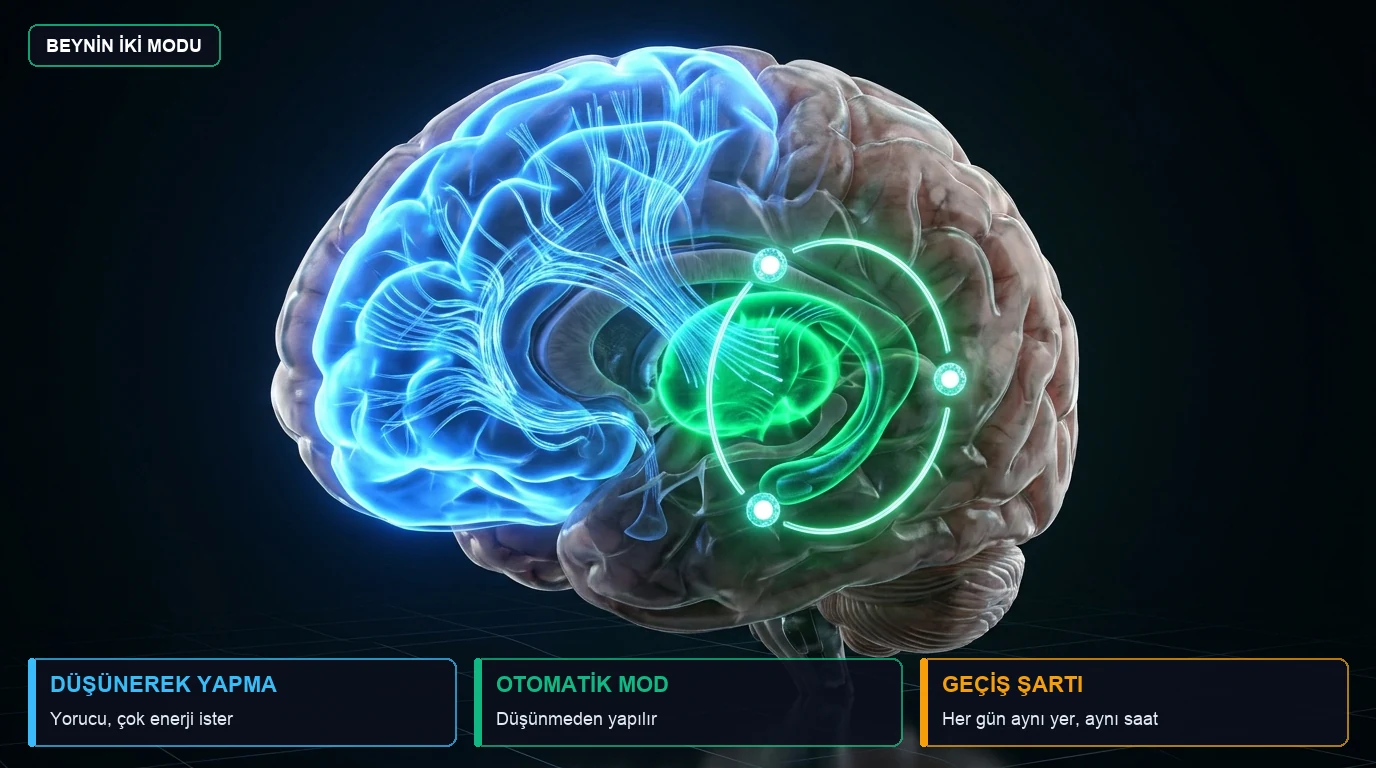
Psychologist Wendy Wood explains that human behavior is governed by two fundamentally distinct neural architectures [8]:
- Goal-Directed System (Prefrontal Cortex): Recruited when learning a novel tool or procedure. It requires deliberate conscious focus, operates slowly, and consumes tremendous glucose and metabolic energy. When mental fatigue or deadline pressure hits, the prefrontal cortex readily disengages.
- Habitual System (Dorsolateral Striatum & Basal Ganglia): Once a behavior is repeated in response to the exact same environmental cue in the exact same physical context, neural control shifts to the subcortical striatum. The behavior becomes automatic, running with virtually zero cognitive effort—like brushing your teeth in the morning.
The vulnerability: If a new productivity tool is slow, requires multiple asynchronous clicks, or sits tucked away on a separate device rather than on your primary desktop screen, it never migrates into the basal ganglia habit loop. The moment you face high stress, your brain reflexively reverts to old, entrenched neural pathways [8].
The 21-Day Myth: Real Habits Take 66 Days
The ubiquitous pop-psychology claim that “habits form in 21 days” lacks empirical validity.
In a landmark longitudinal study conducted at University College London, Dr. Phillippa Lally and colleagues tracked 96 participants adopting novel daily behaviors over 12 consecutive weeks [9]:
- The average time required to achieve asymptotic behavioral automaticity was 66 days.
- Depending on behavioral complexity and individual variation, automaticity took between 18 and 254 days.
- Crucially, missing a single day did not derail habit acquisition, provided participants resumed the behavior promptly.
Think of habit formation as forging a walking path through tall grass. During early repetitions, the path is barely perceptible. Only sustained, consistent daily passage flattens the terrain permanently.

4. What Can You Do? 4 Practical Neuro-Ergonomic Strategies
- 1. Batch long-latency tasks before natural breaks: Trigger operations that require minutes of computation immediately before taking a walk or brewing tea, so processing occurs while your eyes are off the screen.
- 2. Write a 1-line 'handoff note' before switching: If you must pivot while waiting, write down your exact next action: "On return: correct column 2 in sales table." This offloads attention residue [4].
- 3. Anchor new tools to existing environmental cues: Do not hide new workflows in isolated applications. Embed them into your primary browser or operating system interface at the exact same hour daily [8, 9].
- 4. Rely on completion chimes instead of screen-watching: Enable an auditory ping when background jobs finish, freeing your visual attention from the hypnotic pull of loading spinners.
The single most potent intervention is Strategy 2. It costs nothing and requires less than 15 seconds. Jotting down a rapid handoff note closes the open cognitive loop, granting working memory permission to disengage fully from the paused task.

Related Guides
- Learn how cognitive limits cause real-world errors in Why Can’t We See What’s Right in Front of Us? Inattentional Blindness & Human Error.
- Discover how notifications hijack dopamine loops in The Neurobiology of Mobile Notifications & Dopamine Loops.
- Learn how active recall transforms learning habits in How to Change Note-Taking Habits for Faster Learning.
Scientific Evidence & Confidence Levels
| Principle / Finding | Evidence Level |
|---|---|
| System response latency triggers anterior insula/dACC salience activation and autonomic stress | 🟢 Strong Evidence |
| Switching away from unfinished tasks leaves persistent attention residue that impairs subsequent focus | 🟢 Strong Evidence |
| Frequent multitasking and task-switching wastes up to 40% of productive cognitive bandwidth | 🟢 Strong Evidence |
| Habit automaticity requires consistent contextual repetition over an average of 66 days | 🟢 Strong Evidence |
| Pop-culture belief that “any habit forms in 21 days” | 🔴 Inadequate (Empirically refuted) |
💡 Understanding Evidence Levels:
- 🟢 Strong: Confirmed by multiple independent randomized neuroimaging experiments, psychophysiological measurements, and longitudinal cohorts.
- 🟡 Emerging: Promising preliminary trials with smaller sample sizes requiring broader confirmation.
- 🔴 Inadequate: Popular cultural myths unsupported by controlled empirical science.
Frequently Asked Questions
Why is a 3-second loading screen so intensely irritating?
Your motor cortex expects immediate feedback following a command; unexpected delays trigger the anterior insula and dACC, the brain’s threat and pain salience networks [1]. Studies confirm that delays between 0.5 and 2 seconds elevate skin conductance and induce stronger physical keystroke force [2].
What is the harm in checking my phone while an application loads?
Leaving an unfinished task running causes attention residue, meaning a portion of your conscious working memory remains stranded on the primary task [4]. Toggling between complex tasks can consume up to 40% of your total working time in context-switching overhead [6].
Doesn’t multitasking make us more productive?
You may move through tasks faster, but at a severe neurological cost [7]. Experiments show interrupted individuals accelerate output to compensate for time loss, but suffer significant spikes in stress, frustration, and mental exhaustion within just 20 minutes [7].
How do I turn a new software application into an enduring daily habit?
Use it in response to the exact same environmental cue at the exact same hour every day, without stopping during the initial weeks [8, 9]. Achieving effortless behavioral automaticity takes an average of 66 days; missing a single day does not reset progress [9].
Conclusion
Every second of digital latency is a micro-stressor, and every impulse-driven tab switch leaves cognitive attention residue behind. In isolation, these micro-interruptions appear negligible; across an eight-hour workday, they exhaust the prefrontal cortex. By scheduling long-latency tasks before physical breaks, writing brief handoff notes, and anchoring new tools into consistent environments, you can safeguard your focus and reclaim cognitive clarity.
Last Updated: October 2026
References & Academic Sources
- [1] Kohrs, C., Angenstein, N., & Brechmann, A. (2016). “Delays in Human-Computer Interaction and Their Effects on Brain Activity.” PLoS ONE, 11(1), e0146250. DOI: 10.1371/journal.pone.0146250 · PMID: 26745874 · PMCID: PMC4712932
- [2] Kohrs, C., Hrabal, D., Angenstein, N., & Brechmann, A. (2014). “Delayed system response times affect immediate physiology and the dynamics of subsequent button press behavior.” Psychophysiology, 51(11), 1178–1184. DOI: 10.1111/psyp.12253 · PMID: 24980983
- [3] Kuhmann, W. (1989). “Experimental investigation of stress-inducing properties of system response times.” Ergonomics, 32(3), 271–280. DOI: 10.1080/00140138908966087 · PMID: 2737177
- [4] Leroy, S. (2009). “Why is it so hard to do my work? The challenge of attention residue when switching between work tasks.” Organizational Behavior and Human Decision Processes, 109(2), 168–181. DOI: 10.1016/j.obhdp.2009.04.002
- [5] Monsell, S. (2003). “Task switching.” Trends in Cognitive Sciences, 7(3), 134–140. DOI: 10.1016/S1364-6613(03)00028-7 · PMID: 12639695
- [6] Rubinstein, J. S., Meyer, D. E., & Evans, J. E. (2001). “Executive control of cognitive processes in task switching.” Journal of Experimental Psychology: Human Perception and Performance, 27(4), 763–797. DOI: 10.1037/0096-1523.27.4.763 · PMID: 11518143
- [7] Mark, G., Gudith, D., & Klocke, U. (2008). “The cost of interrupted work: more speed and stress.” Proceedings of the SIGCHI Conference on Human Factors in Computing Systems (CHI ‘08), 107–110. DOI: 10.1145/1357054.1357072
- [8] Wood, W., & Rünger, D. (2016). “Psychology of Habit.” Annual Review of Psychology, 67, 289–314. DOI: 10.1146/annurev-psych-122414-033417 · PMID: 26361052
- [9] Lally, P., van Jaarsveld, C. H. M., Potts, H. W. W., & Wardle, J. (2010). “How are habits formed: Modelling habit formation in the real world.” European Journal of Social Psychology, 40(6), 998–1009. DOI: 10.1002/ejsp.674
For informational purposes only; consult a physician for medical diagnosis or treatment.