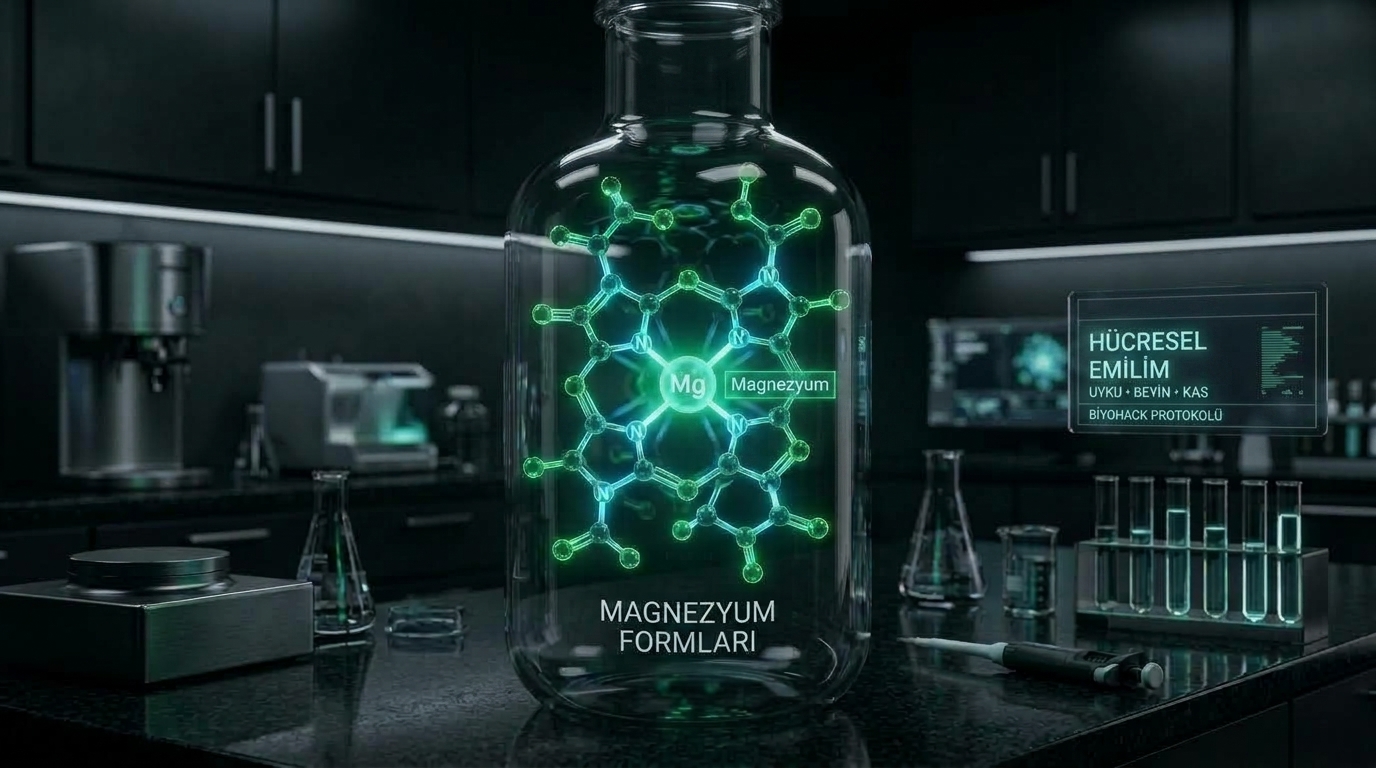
- → Cofactor Synergy: Active Vitamin D3 (calcitriol) and active B6 (P5P) accelerate cellular magnesium uptake by up to 30% while reducing renal clearance.
- → The Only Form Crossing the Blood-Brain Barrier: Magnesium L-Threonate is the only form proven to elevate cerebrospinal fluid (CSF) magnesium levels by 15% and increase hippocampal synapse density.
- → The Magnesium Oxide Fallacy: Despite displaying high elemental magnesium content, its fractional absorption rate is a dismal ~4%; it primarily draws osmotic water into the colon, causing diarrhea.
⚠️ Medical Disclaimer: This guide synthesizes biochemical and clinical literature on magnesium pharmacokinetics and does not substitute for personalized medical diagnosis or treatment. Individuals with chronic kidney disease, severe bradycardia, or taking prescription diuretics or tetracycline antibiotics must consult their physician before supplementing.
Why Magnesium Matters: The Master Bio-Cofactor
Magnesium is an essential biological cofactor participating in over 600 enzymatic reactions in human physiology—from cellular ATP energy synthesis and genomic DNA repair to muscle relaxation and neurotransmitter balance.
Yet, broad epidemiological investigations from the World Health Organization (WHO) and NHANES data reveal that 56% to 68% of modern adults fail to achieve the estimated average requirement (EAR) for dietary magnesium [1, 3]. Chronic daily fatigue, tension headaches, nocturnal leg cramps, anxiety, and fragmented sleep represent classic hallmarks of subclinical deficiency.
However, walking into a pharmacy reveals a bewildering array of magnesium compounds. Whether a supplement reaches your brain, relieves your cramps, or simply triggers rapid digestive distress depends entirely on the chelating molecule to which the magnesium ion is bound.
In this guide, we break down the definitive clinical differences between the six major magnesium forms and help you identify the precise protocol for your biological goals.
1. Why Doesn’t Every Form Work the Same? (Absorption Kinetics)
Magnesium absorption along the small intestine is governed by two distinct physiological mechanisms [2, 4]:
- 1. Paracellular Passive Transport (Jejunum & Ileum — 80% to 90%): Magnesium ions slip through the intercellular tight junction spaces (tight junctions regulated by Claudin-16 and Claudin-19). This route depends strictly on concentration gradients and electrochemical potential differences.
- 2. Transcellular Active Transport (Distal Colon & Cecum — 10% to 20%): Apical entry is mediated by TRPM6 and TRPM7 (Transient Receptor Potential Melastatin) ion channels, while basolateral extrusion into systemic circulation relies on Na⁺/Mg²⁺ exchangers (SLC41A1 and CNNM2 carriers).
Inorganic salts like Magnesium Oxide fail to ionize efficiently at neutral intestinal pH. Because unabsorbed ions remain trapped in the intestinal lumen, they exert high osmotic pressure, pulling water into the bowel and yielding an absorption rate of merely 4% to 8%, frequently inducing loose stools [4, 5].
Conversely, organically chelated forms—such as Bisglycinate, Malate, or Threonate—utilize intact amino acid and monocarboxylate transport pathways. They bypass inorganic carrier saturation, delivering 30% to 45% fractional absorption with zero gastrointestinal irritation [4, 6].
💡 What Does “Chelate” Mean in Biochemistry?
Derived from the ancient Greek word khēlē (“crab’s claw”), chelation describes a stable ring structure where two organic ligand arms tightly clamp a central magnesium ion. Because intestinal enterocytes recognize the complex as a dietary peptide rather than an irritating mineral salt, they pull it across the brush border like a molecular Trojan Horse.
2. Stoichiometric and Clinical Comparison Matrix of the 6 Forms
| Magnesium Form | Chemical Formula | Elemental Mg²⁺ Ratio | Bioavailability Kinetics [4, 6] | Primary Clinical Target | Optimal Timing |
|---|---|---|---|---|---|
| Magnesium Bisglycinate | C₄H₈MgN₂O₄ | 14.1% (1000 mg = 141 mg Mg) | Very High (Peptide transport pathway) | Sleep latency, GABAergic relaxation, nocturnal muscle cramps | 60 minutes before bed |
| Magnesium L-Threonate | C∈H₁₄MgO₁₀ | 7.2% (1000 mg = 72 mg Mg) | Very High (Crosses Blood-Brain Barrier) | Synaptic density, episodic memory, executive focus | Morning / Pre-study |
| Magnesium Malate | C₄H₄MgO₅ | 15.5% (1000 mg = 155 mg Mg) | High (Krebs cycle substrate) | Mitochondrial ATP production, fibromyalgia, daytime energy | Morning / Before noon |
| Magnesium Citrate | C₁₂H₁₀Mg₃O₁₄ | 16.2% (1000 mg = 162 mg Mg) | Moderate-High (Mild osmotic effect) | Sluggish bowel motility, acute constipation, kidney stone prophylaxis | With meals during the day |
| Magnesium Taurate | C₄H₁₂MgN₂O₆S₂ | 8.9% (1000 mg = 89 mg Mg) | High (Cardiovascular synergy) | Cardiac rhythm, arterial elasticity, blood pressure balance | Morning or Evening |
| Magnesium Oxide | MgO | 60.3% (1000 mg = 603 mg Mg) | Very Low (4%) (High osmotic drag) | Antacid for gastric reflux / Laxative | (Not recommended for systemic deficiency) |
3. How Magnesium Optimizes Brain Function and Sleep Architecture
3.1. Magnesium L-Threonate and Synaptic Density
Standard oral magnesium formulations fail to elevate cerebrospinal fluid (CSF) concentrations because the capillary endothelial cells forming the blood-brain barrier tightly regulate active mineral transport [7].
In a landmark investigation published in Neuron, Slutsky and colleagues demonstrated that Magnesium L-Threonate is the only form capable of increasing CSF magnesium concentrations by 15% in mammalian models [7]. This targeted influx upregulated the expression of NMDA receptor subunit GluN2B, dramatically increasing functional synapse density within the hippocampal CA1 subfield and enhancing working memory.
3.2. Magnesium Bisglycinate and Central GABA-A Neurotransmission
Glycine serves as an inhibitory neurotransmitter in the brainstem and spinal cord. While the divalent magnesium ion exerts a voltage-dependent physiological block on excitotoxic NMDA receptors, the co-delivered glycine ligand binds to inhibitory glycine and GABA-A receptor complexes.
This dual-action synergy accelerates sleep onset latency, prolongs restorative slow-wave sleep (NREM Stage 3/4), and dampens nocturnal cortisol surges without next-morning grogginess [8].
4. Essential Cofactors: What to Pair with Magnesium
Magnesium homeostasis does not occur in biological isolation. Optimizing cellular utilization requires three synergistic micronutrients [2, 6]:
- Active Vitamin D3 (1,25-Dihydroxyvitamin D3): Stimulates the transcriptional expression of apical TRPM6 epithelial transport channels in the intestine, boosting fractional magnesium absorption [6].
- Pyridoxal-5-Phosphate (Active B6 / P5P): Facilitates active transmembrane influx into intracellular compartments while curbing unnecessary renal wasting [6].
- The Calcium-to-Magnesium Ratio (2:1): Excess dietary calcium competes directly for the same paracellular tight-junction pathways. Maintaining a balanced 2:1 dietary calcium-to-magnesium ratio prevents competitive absorption inhibition [2].
5. Frequently Asked Questions (FAQ)
Should magnesium be taken with meals or on an empty stomach?
Most chelated forms are best consumed with a light meal or 1–2 hours after dinner. While Magnesium Bisglycinate is exceptionally gentle on the stomach, forms like Citrate or Oxide can trigger cramping if ingested completely fasted.
Does magnesium cause weight gain?
No. Magnesium contains zero calories. By improving intracellular insulin receptor sensitivity and lowering evening cortisol, magnesium supports healthy metabolic regulation and prevents stress-induced sugar cravings.
Are multi-blend magnesium complexes (3-in-1 or 4-in-1) effective?
Yes, for general wellness. Formulations combining Bisglycinate, Malate, and Citrate offer balanced benefits spanning daytime energy, muscle tone, and regular digestion. However, if your target is specifically deep sleep (pure Bisglycinate) or cognitive performance (pure L-Threonate), single-ingredient clinical doses deliver more predictable results.
Which form causes loose stools, and which does not?
Magnesium Oxide and high-dose Magnesium Citrate draw water into the colon, causing a pronounced laxative effect. If you have a sensitive digestive system or wish to avoid bowel looseness entirely, choose Magnesium Bisglycinate.
References & Academic Citations
- National Institutes of Health (NIH) Office of Dietary Supplements. (2024). Magnesium: Fact Sheet for Health Professionals. U.S. Department of Health and Human Services.
- de Baaij, J. H., Hoenderop, J. G., & Bindels, R. J. (2015). Magnesium in man: implications for health and disease. Physiological Reviews, 95(1), 1–46. DOI: 10.1152/physrev.00012.2014 | PMID: 25540140
- Rosanoff, A., Weaver, C. M., & Rude, R. K. (2012). Suboptimal magnesium status in the United States: are the health consequences underestimated? Nutrition Reviews, 70(3), 153–164. DOI: 10.1111/j.1753-4887.2011.00465.x
- Firoz, M., & Graber, M. (2001). Bioavailability of US commercial magnesium preparations. Magnesium Research, 14(4), 257–262. PMID: 11794633
- Walker, A. F., et al. (2003). Mg citrate found more bioavailable than other Mg preparations in a randomised, double-blind study. Magnesium Research, 16(3), 183–191. PMID: 14596323
- Gröber, U., Schmidt, J., & Kisters, K. (2015). Magnesium in Prevention and Therapy. Nutrients, 7(9), 8199–8226. DOI: 10.3390/nu7095388 | PMID: 26404370
- Slutsky, I., et al. (2010). Enhancement of learning and memory by elevating brain magnesium. Neuron, 65(2), 165–177. DOI: 10.1016/j.neuron.2009.12.026 | PMID: 20152124
- Abbasi, B., et al. (2012). The effect of magnesium supplementation on primary insomnia in elderly: A double-blind placebo-controlled clinical trial. Journal of Research in Medical Sciences, 17(12), 1161–1169. PMID: 23853635
For informational purposes only; consult a physician for medical diagnosis or treatment.