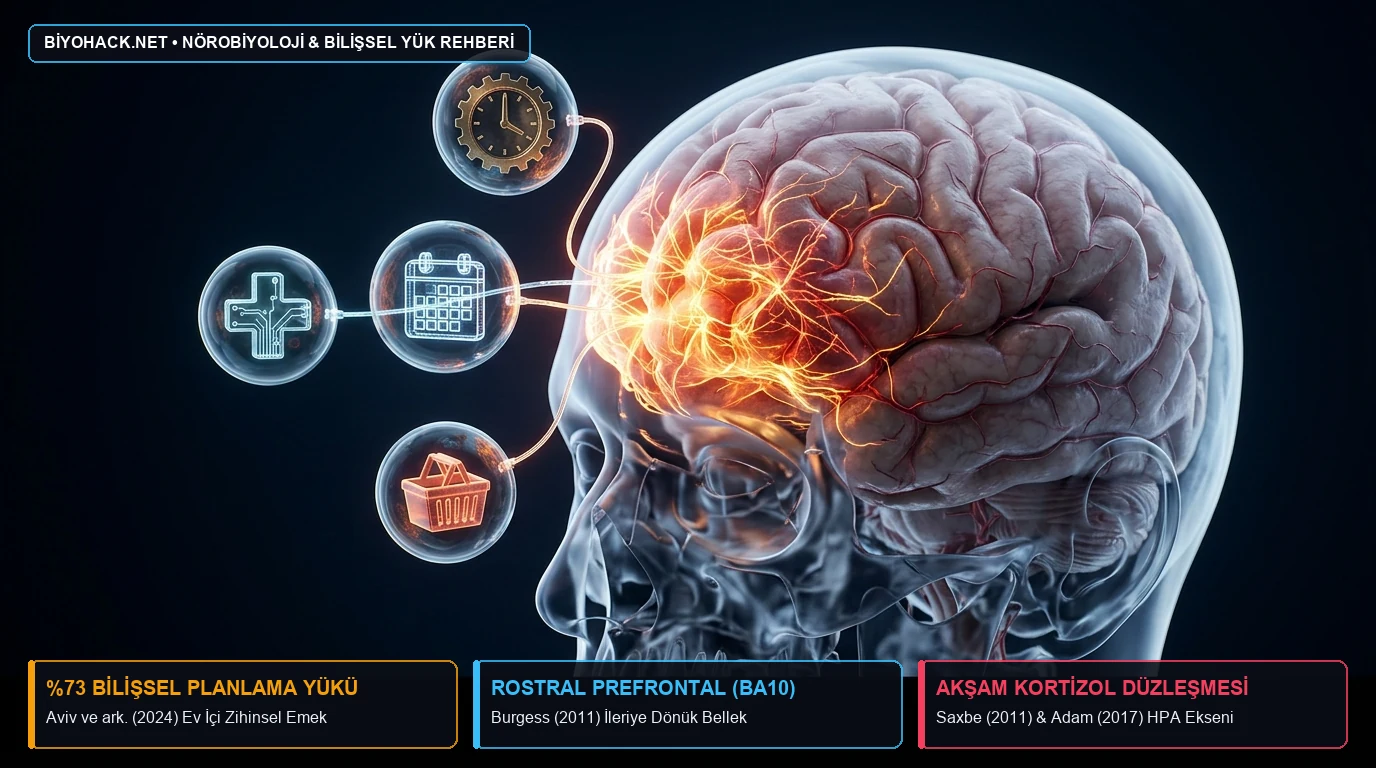
- → 73% of Planning Falls on One Person: Studies reveal women carry 64% of physical household tasks and 73% of invisible cognitive labor and monitoring (Daminger, 2019; Aviv et al., 2024).
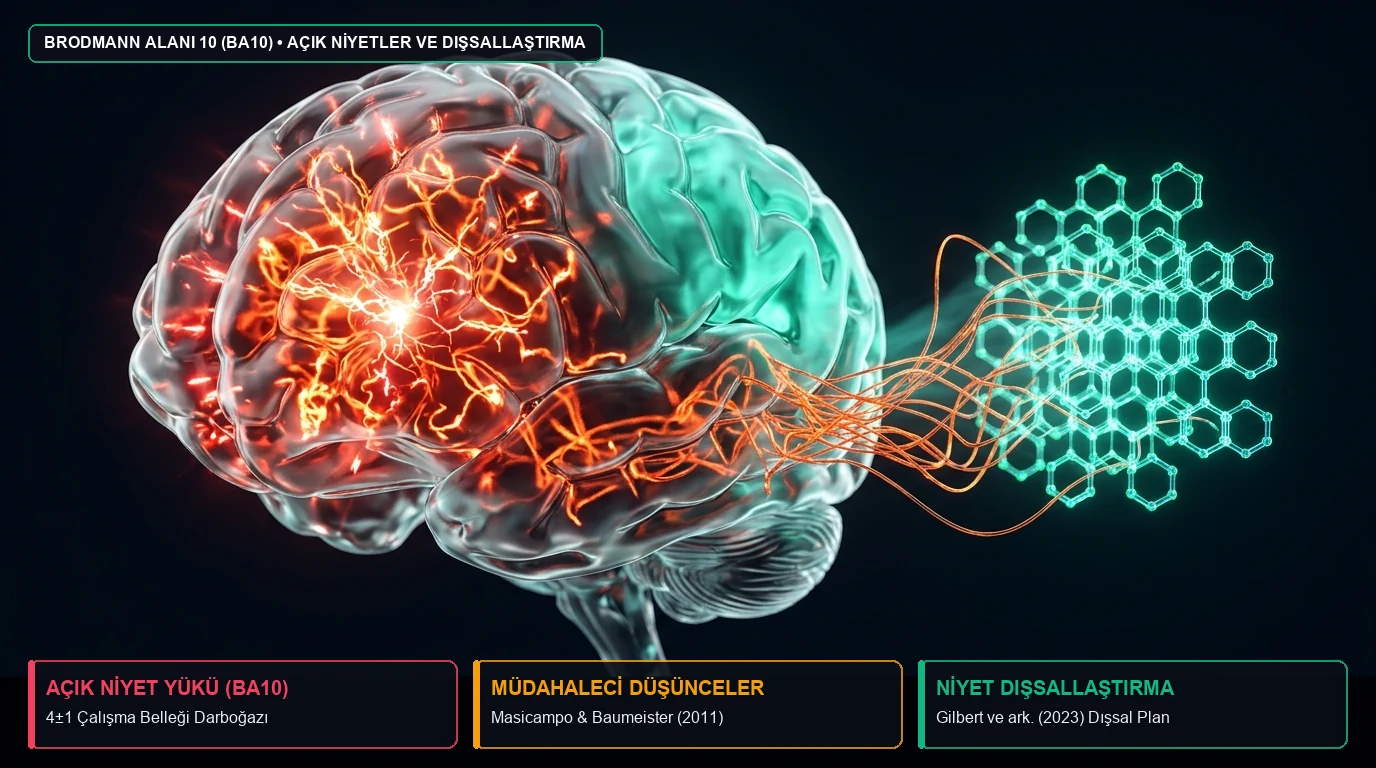
- → Unfinished Chores Act as Open Browser Tabs: Holding prospective tasks in mind continuously occupies the rostral prefrontal cortex in the background (Burgess et al., 2011; Masicampo & Baumeister, 2011).
- → Evening Mental Labor Blocks Cortisol Recovery: Ongoing domestic planning after work keeps evening cortisol elevated, disrupting circadian recovery and sleep depth (Saxbe et al., 2011; Adam et al., 2017).
- → Cognitive Offloading Relieves Working Memory: Exporting tasks to external tools prevents prospective memory lapses; full recovery, however, requires end-to-end ownership sharing (Risko & Gilbert, 2016; Gilbert et al., 2023).
⚠️ Informational Notice: This article is for general educational purposes based on peer-reviewed scientific literature; it does not replace medical diagnosis or psychological treatment. If you suffer from chronic insomnia, severe burnout, anxiety, or depression, please consult a qualified healthcare provider.
In Brief
- Invisible mental load encompasses the continuous cognitive work of anticipating, researching, deciding, and monitoring required to manage a household or team [1].
- Every “I must not forget this” note you hold in your head consumes energy like an open browser tab in your working memory [5, 6].
- When this mental checklist runs late into the evening, stress hormones fail to decline, fragmenting nocturnal sleep architecture [9, 10].
- Merely splitting chores with “tell me what to do and I’ll do it” fails to resolve the burden; true relief requires end-to-end ownership of specific domains [1, 2].
Does This Sound Familiar?
It is 9:30 PM. Two people are sitting side by side on the sofa. To an outside observer, both appear to be relaxing.
Yet while one partner’s mind has genuinely powered down, the other’s brain is running an invisible marathon: What should I pack for school lunches tomorrow? We are running low on laundry detergent. What day was the parent-teacher conference? Have the kids outgrown their winter coats? Did we schedule my mother’s prescription refill?
The well-intentioned household phrase “You should have just told me what to do, and I would have done it!” cuts straight to the biological core of the problem. Anticipating needs in advance, researching solutions, making decisions, and tracking follow-through is inherently the most neurologically demanding half of the labor [1, 2].
A recent discourse highlighted in The New York Times discussed AI tools being marketed to women as “domestic organization assistants.” This prompts a critical neurobiological question: Does technology genuinely alleviate this invisible burden, or does it merely saddle the same person with an intensified management workload?

1. Doing the Work vs. Thinking the Work
Cooking a meal or running the dishwasher are tangible tasks with clear physical starting points and visible conclusions. However, Harvard sociologist Allison Daminger demonstrated that the primary engine sustaining a home is the cognitive and managerial labor that takes place long before hands ever touch a chore [1].
Daminger broke down domestic cognitive labor into four distinct stages [1]:
| Stage | Real-World Manifestation | Who Carries It Predominantly? |
|---|---|---|
| 1. Anticipating | Recognizing needs before problems occur (“Winter is coming; the kids’ boots might be too small”). | Disproportionately women (>70%) [1, 2]. |
| 2. Identifying Options | Researching solutions; finding the right specialist, extracurricular, or product. | Predominantly women [1]. |
| 3. Decision Making | Making the final choice among available options. | The stage couples most frequently share jointly [1]. |
| 4. Monitoring | Verifying follow-through (“Did the pediatrician get the signed immunization record?”). | Disproportionately women [1, 2]. |

The Drain Stems from Cognitive Tracking, Not Physical Effort
Dr. Elizabeth Aviv and colleagues at the University of Southern California investigated 30 distinct domestic responsibilities across 322 mothers [2]. Measuring physical chore execution independently from cognitive planning revealed striking disparities:
- While mothers performed 64% of physical household tasks, they shouldered 73% of invisible anticipation and monitoring alone [2].
- More importantly, total physical chore volume did not correlate directly with psychological deterioration. Rather, clinically elevated stress, depressive symptoms, maternal burnout, and marital dissatisfaction were strongly predicted by the concentration of cognitive labor onto a single partner [2].
Additional research confirms that this invisible domestic load interferes with nocturnal sleep quality and significantly impairs daytime executive focus in professional settings [3, 4].

2. “Open Tabs” in the Brain: Why Remembering Exhausts Us
Why does holding an internal to-do list feel exhausting even when you are sitting perfectly motionless? Because keeping future intentions alive in prospective memory demands constant neurobiological vigilance.
The Rostral Prefrontal Cortex on Guard
Retrieving a past memory is passive; it resurfaces when prompted. However, prospective memory—remembering to carry out an intended action in the future (“Call the pediatrician at 5:00 PM”, “Pick up groceries on the commute home”)—operates under entirely different neural circuitry [5].
Functional neuroimaging led by Paul Burgess and colleagues at University College London demonstrates that holding delayed intentions in mind recruits the rostral prefrontal cortex (Brodmann Area 10), located at the front pole of the brain [5]. While you engage in ongoing tasks, BA 10 remains in a continuous state of background surveillance, monitoring external time and environmental cues: “Is it time yet? What did I leave pending?”
Crucially, working memory capacity is strictly bounded, holding roughly 3 to 5 chunks of information simultaneously. Every pending household reminder held in prospective memory usurps bandwidth from this precious cognitive workspace [4, 5].
Externalizing Plans Silences the Neural Alarm
Psychologists E. J. Masicampo and Roy Baumeister demonstrated how unfulfilled goals disrupt attentional control—and how to short-circuit this fatigue [6]:
- Participants instructed to contemplate an impending, uncompleted task experienced persistent intrusive thoughts, resulting in sharp performance drops on subsequent cognitive reading tests [6].
- In contrast, when participants drafted a concrete execution plan (“where, when, and how will this be done?”), the background cognitive alarm shut off completely, restoring cognitive performance even though the task itself remained unfinished [6].
Herein lies the exhaustion of domestic mental load: unlike a corporate project with a defined deliverables sign-off, family maintenance presents a perpetual cycle, continuously generating unclosed browser tabs in the mind [4].
3. Why Can’t We Relax in the Evening?
Under healthy circadian regulation, cortisol (our primary glucocorticoid stress hormone) peaks shortly after awakening and gradually slopes downward across the afternoon, reaching a diurnal nadir before bedtime to permit slow-wave sleep [10].
The Domestic “Second Shift” and Flattened Cortisol Slopes
Darby Saxbe and Rena Repetti at UCLA tracked salivary cortisol profiles in couples following their return home from workplace environments [9]:
- Spouses entering an ongoing evening whirlwind of domestic demands failed to demonstrate healthy physiological recovery from workday stress [9].
- In mothers shouldering continuous organizational tracking, evening cortisol failed to decline, creating a flattened diurnal cortisol slope [9].
- A landmark meta-analysis of 80 studies by Emma Adam and colleagues established that flattened diurnal cortisol curves are clinically associated with insomnia, major depression, systemic inflammation, and compromised immune defenses [10].
This sustained nocturnal sympathetic arousal impairs vagal tone and heart rate variability (HRV), preventing autonomic downregulation during rest. Consequently, one enters sleep in an activated state, awakening unrefreshed [3, 9, 10].

4. Practical Interventions: 4 Evidence-Based Protocols
- 1. Externalize Reminders onto a Shared Calendar: Move recurring operational milestones (bills, medical checks, school deadlines) out of biological working memory into an external, synchronized calendar [7, 8].
- 2. Delegate Complete Domains, Not Fragmented Tasks: Replace "tell me what to do" by transferring full end-to-end ownership (anticipating, researching, executing, and tracking) of a specific domain (e.g., pediatric healthcare or school logistics) [1, 2].
- 3. Implement a 5-Minute Evening Brain Dump: One hour before sleep, write down pending tasks with explicit times for tomorrow. Formalizing the plan halts rostral prefrontal background vigilance [6].
- 4. Automate Operations, Guard Emotional Presence: Delegate administrative friction to shared tools, reserving human cognitive bandwidth for genuine connection with family members [7].
The simplest and most immediate protocol is Step 3: Tonight, one hour before bed, take a pen and write down the top 3 looming tasks along with their specific execution windows for tomorrow. Once the brain verifies that an execution architecture is established, the vigilance signal subsides [6].
Research on cognitive offloading by Evan Risko and Sam Gilbert confirms that transferring intentions to external tools not only safeguards against prospective memory failures, but also dramatically frees up focal attention for immediate cognitive tasks [7, 8]. However, if digital tools are managed by just one partner acting as family project manager, burnout remains unaddressed. True resolution requires end-to-end domain ownership [1, 2].

Evidence Level & Scientific Reliability
| Finding | Evidence Level |
|---|---|
| Disproportionate concentration of domestic cognitive load (>70%) on women independent of physical chores and its correlation with burnout | 🟢 Strong |
| Prospective memory tasks recruiting BA 10 and exhausting finite working memory capacity | 🟢 Strong |
| Failure of evening cortisol to decline driving sleep fragmentation and neuroimmune distress | 🟢 Strong |
| Implementation intention planning and cognitive offloading relieving working memory fatigue | 🟢 Strong |
| Downloading productivity apps alone resolving domestic burnout without equitable division | 🔴 Insufficient (Systemic sharing required) |
💡 Understanding Evidence Levels
- 🟢 Strong: Validated by multiple peer-reviewed human clinical trials, meta-analyses, and broad scientific consensus.
- 🟡 Emerging: Preliminary human cohorts or limited sample sizes showing promising physiological trajectories.
- 🔴 Insufficient: Inconclusive, contradictory, or lacking robust controlled clinical validation.
Frequently Asked Questions
What distinguishes invisible mental load from routine household chores?
Physical chores (sweeping, washing dishes) have clear physical boundaries, beginning and ending with manual action; cognitive labor (anticipating, planning, deciding, and tracking) operates continuously in the neural background [1, 4]. Research indicates mothers carry 64% of physical chores but 73% of mental planning, with the latter serving as the direct driver of psychological exhaustion and maternal burnout [2].
Why do unfinished mental to-do lists impair daily focus?
The brain’s rostral prefrontal cortex maintains background vigilance to prevent future intention loss, constantly monitoring environmental triggers and consuming finite working memory capacity [5]. Formulating a concrete, written execution plan (“when, where, and how”) satisfies prospective memory circuits, turning off the intrusive alarm and freeing up cognitive bandwidth [6].
How does continuous evening mental load harm physical health?
Ongoing domestic coordination prevents the natural diurnal down-regulation of cortisol [9]. According to a systematic review of 80 empirical studies, flattened diurnal cortisol slopes are clinically linked to severe sleep architecture disruption, emotional depression, and systemic immune vulnerability [10].
Can shared digital calendars and AI apps solve mental load?
Offloading calendar dates and recurring reminders to external systems effectively prevents cognitive lapses and reduces mental friction [7, 8]. However, if one individual continues to shoulder the burden of inputting data, delegating tasks, and nagging others to check the app, the psychological load remains unresolved. Domains must be transferred with complete autonomy [1, 2].
Conclusion
Invisible mental load is not a personal failure of organizational willpower; it is the physiological cost of running dozens of unclosed operational tabs in your brain. Systematically externalizing reminders onto shared tools and transitioning from “tell me what to do” to end-to-end domain ownership creates the psychological and hormonal space necessary for genuine recovery.
Last Updated: October 2026
Verified Bibliography & Scientific References
- [1] Daminger, A. (2019). “The Cognitive Dimension of Household Labor.” American Sociological Review, 84(4), 609–633. DOI: 10.1177/0003122419859007
- [2] Aviv, E., Waizman, Y., Kim, E., Liu, J., Rodsky, E., & Saxbe, D. E. (2024). “Cognitive household labor: gender disparities and consequences for maternal mental health and wellbeing.” Archives of Women’s Mental Health, 28, 5–14. DOI: 10.1007/s00737-024-01490-w · PMID: 38951218 · PMCID: PMC11761833
- [3] Wayne, J. H., Mills, M. J., Wang, Y. R., Matthews, R. A., & Whitman, M. V. (2023). “Who’s Remembering to Buy the Eggs? The Meaning, Measurement, and Implications of Invisible Family Load.” Journal of Business and Psychology, 38(6), 1159–1184. DOI: 10.1007/s10869-023-09887-7 · PMID: 37359080. Additional reference: Dean, L., Churchill, B., & Ruppanner, L. (2022). Community, Work & Family, 25(1), 13–29. DOI: 10.1080/13668803.2021.2002813
- [4] Reich-Stiebert, N., Froehlich, L., & Voltmer, J. B. (2023). “Gendered Mental Labor: A Systematic Literature Review on the Cognitive Dimension of Unpaid Work Within the Household and Childcare.” Sex Roles, 88(11–12), 475–494. DOI: 10.1007/s11199-023-01362-0 · PMID: 37283733 · PMCID: PMC10148620
- [5] Burgess, P. W., Gonen-Yaacovi, G., & Volle, E. (2011). “Functional neuroimaging studies of prospective memory: what have we learnt so far?” Neuropsychologia, 49(8), 2246–2257. DOI: 10.1016/j.neuropsychologia.2011.02.014 · PMID: 21329712. Foundational paper: Burgess, P. W., Quayle, A., & Frith, C. D. (2001). Neuropsychologia, 39(6), 545–555. PMID: 12075901
- [6] Masicampo, E. J., & Baumeister, R. F. (2011). “Consider it done! Plan making can eliminate the cognitive effects of unfulfilled goals.” Journal of Personality and Social Psychology, 101(4), 667–683. DOI: 10.1037/a0024192 · PMID: 21688924
- [7] Risko, E. F., & Gilbert, S. J. (2016). “Cognitive Offloading.” Trends in Cognitive Sciences, 20(9), 676–688. DOI: 10.1016/j.tics.2016.07.002 · PMID: 27542527
- [8] Gilbert, S. J., Boldt, A., Sachdeva, C., Scarampi, C., & Tsai, P. C. (2023). “Outsourcing memory to external tools: A review of ‘intention offloading’.” Psychonomic Bulletin & Review, 30(1), 60–76. DOI: 10.3758/s13423-022-02193-7 · PMID: 36357732 · PMCID: PMC9938007
- [9] Saxbe, D. E., Repetti, R. L., & Graesch, A. P. (2011). “Time spent in housework and leisure: Links with parents’ physiological recovery from work.” Journal of Family Psychology, 25(2), 271–281. DOI: 10.1037/a0023048 · PMID: 21480706. Foundational paper: Saxbe, D. E., Repetti, R. L., & Nishina, A. (2008). Health Psychology, 27(1), 15–25. PMID: 18230009
- [10] Adam, E. K., Quinn, M. E., Tavernier, R., McQuillan, M. T., Dahlke, K. A., & Gilbert, K. E. (2017). “Diurnal cortisol slopes and mental and physical health outcomes: A systematic review and meta-analysis.” Psychoneuroendocrinology, 83, 25–41. DOI: 10.1016/j.psyneuen.2017.05.018 · PMID: 28578301 · PMCID: PMC5568897
For informational purposes only; consult a physician for medical diagnosis or treatment.