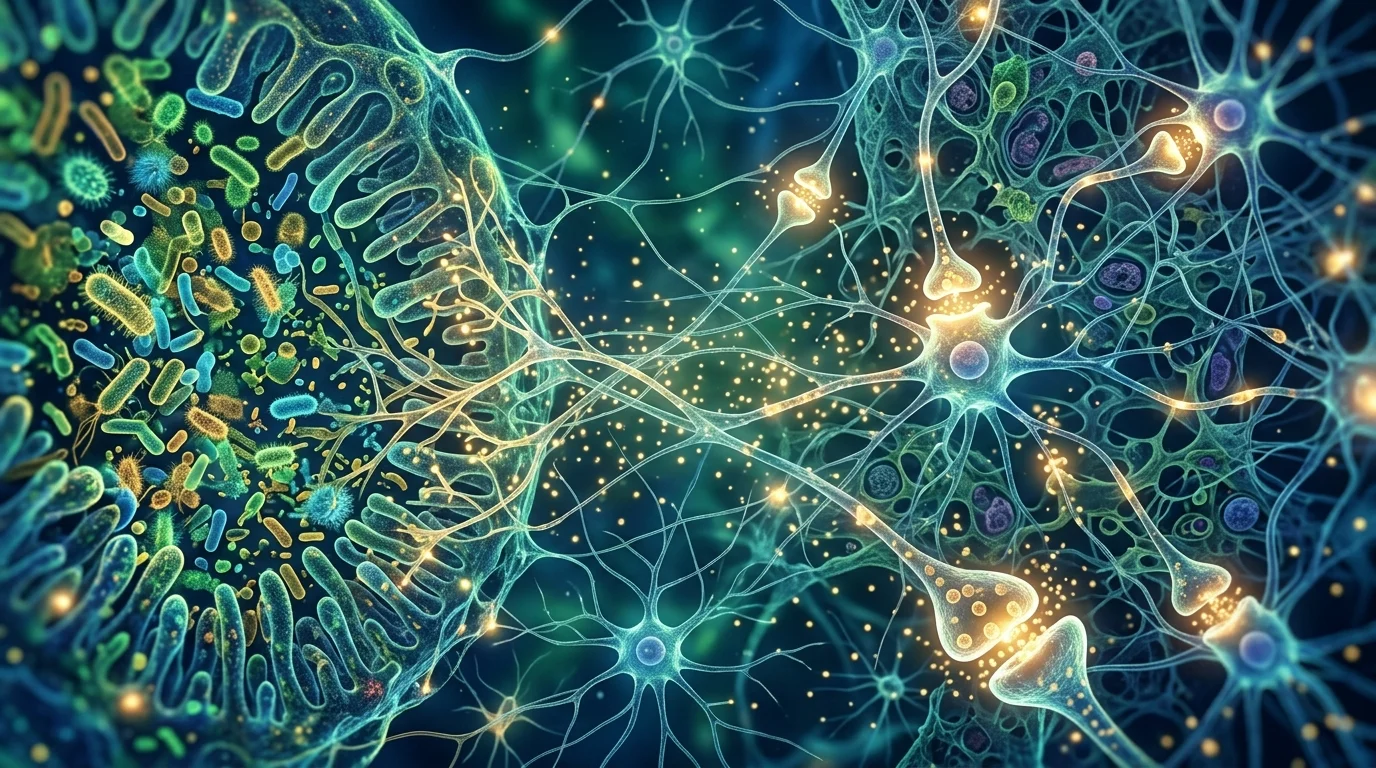
- → Bidirectional Signaling: The gastrointestinal tract and the central nervous system constantly exchange signals via the vagus nerve, immune cytokines, and endocrine pathways.
- → Serotonin and Tryptophan: The enzymatic conversion of dietary tryptophan into serotonin depends heavily on a balanced, uninflamed enteric microenvironment.
- → Mediterranean Framework: Diets rich in fermentable fiber, legumes, polyphenols, and omega-3 seafood cultivate a diverse microbiome and bolster psychological resilience.
- → Evidence Limits for Probiotics: While psychobiotics can shift biochemical markers (BDNF, cytokines), robust clinical human proof of direct mood enhancement remains developing.
⚖️ Medical Disclaimer: This article is strictly for informational and educational purposes and does not substitute for professional medical consultation, diagnosis, or clinical psychiatric care.
Quick Summary
- Primary Finding: The gut and brain maintain continuous bidirectional communication; our dietary patterns and intestinal microbiota directly participate in regulating mood-governing neurochemicals, including serotonin and GABA [1].
- Strength of Evidence: Preclinical mechanisms and biological biomarkers are compelling; however, large-scale randomized human trials proving direct, reproducible clinical mood improvement from targeted probiotic interventions remain in development [2].
- Clinical Relevance: The existing literature primarily evaluates individuals exhibiting anxiety or stress symptoms; for the general public, a Mediterranean-style pattern rich in dietary fiber, omega-3 fatty acids, and polyphenols provides an optimal foundation for mental resilience [4].
Have you ever found yourself feeling irritable or emotionally fragile after an exhausting day without any obvious trigger? We instinctively attribute these fluctuations to work deadlines or fatigue.
Yet, emerging neuroscience reveals that events within our digestive tract profoundly shape our emotional state. The gut is far more than a nutrient processing organ; it functions as a sensory powerhouse, engaging in continuous two-way dialogue with the brain through the vagus nerve, immune cytokines, and circulating hormones [1].
How do the meals on our plates influence this biochemical axis? Modern clinical science is systematically untangling this mind-gut highway.
How Does the Gut Communicate with the Brain?
Our gastrointestinal tract and central nervous system are intimately connected via a bidirectional communication highway termed the gut-brain axis [1]. This communication operates across three primary channels: the vagus nerve, mucosal immune cells, and endocrine signaling cascades [1].
As dietary substrates undergo digestion, trillions of co-habiting microorganisms—collectively termed the gut microbiota—metabolize nutrients and release active biochemical byproducts [1]. These microbial metabolites interact directly with enteric neurons and enterochromaffin cells, transmitting messages to the central nervous system [1].
When microbial equilibrium breaks down (dysbiosis) and the intestinal epithelial barrier weakens, low-grade systemic inflammation ensues [3]. Circulating inflammatory cytokines cross the blood-brain barrier, perturbing neurocircuitry involved in emotional regulation and stress reactivity [3].
Does Serotonin Synthesis Originate in the Gut?
Over 90% of the body’s serotonin is synthesized in the gut, and its bio-availability is tightly coupled to enteric microbial balance [3]. Our bodies produce serotonin from tryptophan, an essential amino acid obtained through dietary protein [3].
In a healthy enteric environment, tryptophan is channeled effectively into serotonin synthesis and melatonin pathways [3]. However, when intestinal inflammation rises or barrier integrity falters, the enzyme indoleamine 2,3-dioxygenase (IDO) is upregulated, diverting tryptophan into the kynurenine pathway [3]. This metabolic shunt depletes serotonin availability and generates neurotoxic metabolites (such as quinolinic acid), fostering anxiety and depressive symptoms [3].
Similarly, the synthesis of gamma-aminobutyric acid (GABA)—the central nervous system’s chief calming neurotransmitter—is modulated by specific commensal bacterial strains [3].
During hormonal transitions, such as the perimenopausal window, fluctuating estrogen levels can disrupt intestinal mucosal integrity, exacerbating tryptophan diversion and GABA downregulation, thereby predisposing women to mood volatility and sleep disruption [3].
Which Dietary Patterns Support the Microbiome-Gut-Brain Axis?
Clinical researchers emphasize that the Mediterranean diet provides the most robust nutritional architecture for microbiome stability and psychological well-being [4]. This whole-food model supplies abundant fermentable fiber, legumes, cold-pressed olive oil, and wild fatty fish rich in omega-3 fatty acids [4].
Prebiotic soluble fibers serve as fuel for commensal anaerobic bacteria, promoting the synthesis of short-chain fatty acids (SCFAs) that reinforce the intestinal mucosal barrier and dampen neuroinflammation [4].
While restrictive dietary protocols—such as strict ketogenic regimens, veganism, or prolonged intermittent fasting—also alter microbial diversity, their metabolic impacts vary substantially across individuals [1]. Prioritizing wide botanical diversity on your plate represents a safer, more sustainable strategy for cultivating emotional resilience [4].
Can Probiotics Instantly Alleviate Anxiety and Low Mood?
Supplements containing live beneficial bacteria are classified as probiotics; those specifically investigated for their potential to modulate cognitive or emotional function are termed psychobiotics [2].
Although psychobiotics hold therapeutic promise, current clinical reality warrants tempered expectations [2]. In a comprehensive systematic review encompassing 30 human intervention trials, probiotic supplementation consistently altered biological biomarkers—such as serum serotonin, brain-derived neurotrophic factor (BDNF), and inflammatory cytokines [2]. However, only nine of these studies demonstrated statistically significant, clinically meaningful improvements in subjective mood and anxiety scores [2].
Substantial variations in bacterial strains, colony-forming units (CFUs), and baseline individual microbiome composition explain these disparate outcomes [4]. Probiotics may serve as valuable supportive adjuncts, but they are not standalone psychiatric panaceas [2].
Evidence Quality Appraisal
| Finding | Evidence Level |
|---|---|
| Bidirectional signaling via the gut-brain axis regulates neurobiology | 🟢 Strong |
| Mediterranean dietary patterns support emotional resilience and microbial diversity | 🟡 Emerging |
| Psychobiotics attenuate physiological stress markers and anxiety symptoms | 🟡 Emerging |
| Tryptophan supplementation relieves perimenopausal mood disturbances | 🔴 Insufficient |
💡 Understanding Evidence Levels:
- 🟢 Strong: Validated across numerous independent clinical cohorts, mechanistic models, and broad academic consensus.
- 🟡 Emerging: Supported by preliminary human intervention trials, pilot cohorts, or biomarker studies.
- 🔴 Insufficient: Lacks robust human trial validation, conflicting evidence, or restricted to animal models.
Practical Daily Strategies
To nourish your gut-brain axis and support mental clarity, integrate four evidence-based dietary habits:
- Maximize Botanical Diversity: Aim for 30 different plant foods weekly (vegetables, berries, legumes, herbs, and nuts) to nourish diverse bacterial taxa [4].
- Prioritize Omega-3 Fatty Acids: Consume fatty fish (salmon, sardines, mackerel) or algal oil to downregulate pro-inflammatory cytokine signaling [4].
- Ensure Essential Micronutrient Co-Factors: Maintain adequate intake of folate, vitamins B6 and B12, vitamin D, magnesium, and zinc—vital co-factors in serotonin and GABA enzymatic synthesis [4].
- Rely on Whole Foods Over Isolated Supplements: Individual high-dose probiotic capsules cannot replace a diverse dietary matrix; build your biological resilience from the ground up [4].
Safety and Clinical Considerations
Biochemical responses to dietary modifications and probiotic supplements vary widely depending on individual genetics, metabolic health, and baseline microbiota composition [1, 4].
The clinical trials reviewed predominantly recruited adults experiencing mild-to-moderate stress, subclinical anxiety, or mood symptoms [1, 2, 4]. For individuals with complex chronic conditions, inflammatory bowel diseases, pregnancy, or those taking psychiatric medications (e.g., SSRIs), personalized medical supervision is essential before introducing new supplements [1, 4].
Furthermore, standard therapeutic dosing has not been established for psychobiotics, omega-3s, or micronutrient formulations, with research protocols utilizing widely divergent dosages [4]. Always consult a qualified physician or clinical dietitian prior to initiating high-dose supplementation or restrictive diets [1, 4].
Evidence Summary
- Hetta et al. (2026) [1]: Comprehensive narrative review outlining neural, immune, and endocrine pathways of the gut-brain axis; highlights the mechanistic impact of dietary patterns on microbial ecology while noting the scarcity of long-term human mechanistic trials.
- Dai et al. (2026) [2]: Scoping review of 30 human clinical intervention trials. Probiotic and nutritional interventions reliably modulated peripheral biomarkers (serotonin, BDNF, cytokines), yet only 9 trials demonstrated definitive improvements in psychological scales.
- Zhao & Wu (2026) [3]: Narrative review characterizing estrogen-microbiome interactions during perimenopause; explores tryptophan kynurenine-pathway shunting and GABA dysregulation in preclinical models.
- Hachmeriyan et al. (2026) [4]: Evidence synthesis examining omega-3 fatty acids, psychobiotics, dietary fiber, and micronutrients in anxiety and depression management, supporting the clinical superiority of the Mediterranean diet.
Verified References & Scientific Sources
- Hetta HF, Hassan RAA, Alanazi FE, Alqifari SF, Albalwi MA, Albalawi AA, Bukhari SQ, Alatawi Z, Ellah NHA, Ramadan YN. The Gut-Brain Axis: Neural, Immune, and Endocrine Pathways Connecting Food and Mood. Molecular Nutrition & Food Research. 2026;70(5):e70592. PMID: 42745506 | DOI:
10.1002/mnfr.70592 - Dai Q, Fang C, Du Y, Sun H, Duan Z. Biomarkers mediating the effects of nutritional and probiotic interventions on anxiety and depression: a scoping review of human clinical trials. Frontiers in Nutrition. 2026;13:1856471. PMID: 42760956 | DOI:
10.3389/fnut.2026.1856471 - Zhao H, Wu W. Gut Microbiota, Neurotransmitters, and Mood Regulation in Perimenopausal Women: Mechanistic Insights. Nutrients. 2026;18(13):2185. PMID: 42451185 | DOI:
10.3390/nu18132185 - Hachmeriyan A, Panayotova G, Todorova H. Nutritional Interventions, Psychobiotics, and the Microbiome-Gut-Brain Axis in Depressive and Anxiety Disorders. Nutrients. 2026;18(9):1318. PMID: 42123920 | DOI:
10.3390/nu18091318
For informational purposes only; consult a physician for medical diagnosis or treatment.